Pix vs UPI vs SPEI vs PromptPay: Real-Time Rail Economics Compared
Compare Pix, UPI, SPEI, and PromptPay across confirmation speed, settlement, identifiers, risk controls, and operator trade-offs.
Pix, UPI, SPEI, and PromptPay all deliver T+0 settlement but differ on governance, MDR mandate, and identifier architecture. Pix and UPI mandated zero-MDR to displace cards; SPEI and PromptPay grew alongside cards. The right comparison is not volume but the regulatory model.
The four most-cited real-time payment rails — Pix, UPI, SPEI, and PromptPay — all deliver T+0 final settlement but differ sharply on operator economics. Pix and UPI are mandated zero-MDR systems set by central-bank or government policy; SPEI and PromptPay are market-priced. Pix and UPI achieved mass displacement of cards by making A2A payments free to merchants; SPEI and PromptPay grew alongside cards rather than displacing them. For market-entry operators, the key variables are not adoption volume but governance model, identifier system, and how the regulator priced out the competition.
Every payment operator entering Brazil, India, Mexico, or Thailand faces the same early decision: how to integrate with the local real-time rail. These rails are not optional infrastructure in their respective markets — they are the dominant or mandatory settlement backbone for account-to-account payments, and in some cases for merchant checkout as well. The comparison that circulates most in operator discussions is adoption volume, which is also the least useful metric for market entry decisions.
Consider what the volume numbers actually obscure. UPI at 22.35 billion transactions per month makes every other rail look marginal by count. But SPEI processed MXN 219 trillion in value in 2024 — equivalent to approximately 6.5x Mexican GDP — on 5.34 billion annual transactions. These two systems are not competing for the same economic function. UPI is a mass consumer and small-merchant payment network; SPEI is a high-value interbank and B2B transfer system with a consumer layer (CoDi) that has achieved limited retail penetration. Comparing their transaction counts tells you almost nothing about which is more economically significant or more operationally complex to integrate.
The variables that actually matter for operators are governance model, MDR mandate, identifier architecture, settlement mechanics, and the licensing path required to connect. This comparison works through each in turn across all four rails.
The four rails at a glance
The infographic below summarizes the key operator-facing dimensions across all four rails — launch year, governance, volume, MDR mandate, identifier system, and settlement speed. Every figure is derived from primary sources — regulator publications, operator disclosures, and NPCI/BCB/Banxico/NITMX statistical releases — cited in the sources section. The full underlying comparison table is available below the infographic.
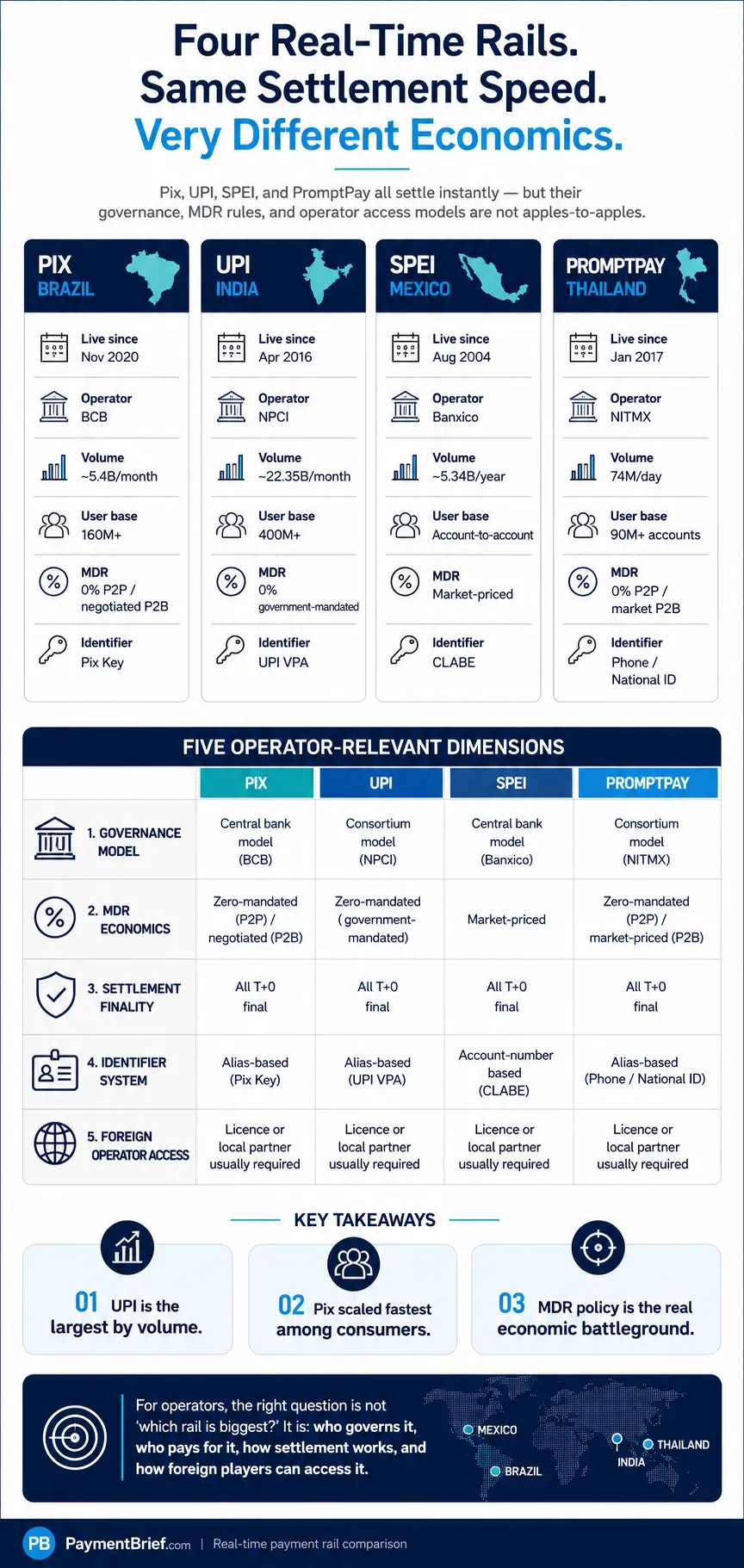
For a wider reference including PayNow, NAPAS 247 / VietQR, InstaPay, and DuitNow — with cross-border readiness status, licensing paths, and per-rail operator watchouts — see the Real-Time Payment Rails Comparison Matrix.
View underlying comparison table
| Dimension | Pix (Brazil) | UPI (India) | SPEI (Mexico) | PromptPay (Thailand) |
|---|---|---|---|---|
| Live since | Nov 2020 | Apr 2016 | Aug 2004 | Jan 2017 |
| Operated by | BCB (central bank) | NPCI (consortium/RBI) | Banxico (central bank) | NITMX (consortium/BOT) |
| Monthly volume | ~5.4B (Sep 2025) | 22.35B (Apr 2026) | ~445M (2024 avg) | ~2.2B (Jun 2025) |
| User base | 160M+ users | 400M+ linked | Account-based (84 participants) | 90M+ registrations |
| Merchant MDR | 0% P2P mandate; P2B market | 0% — policy, notifiable since Aug 2026 | Market-priced | 0% P2P; P2B market |
| Settlement | T+0, irrevocable | T+0, irrevocable | T+0, irrevocable | T+0, irrevocable |
| Identifier | Pix Key (alias) | UPI VPA (alias) | CLABE (account number) | Phone / National ID |
| QR standard | BCB + EMVCo | NPCI Bharat QR | CoDi (layered on SPEI) | Thai QR (EMVCo-compatible) |
| Foreign operator path | PI licence or local partner | PA licence or local partner | IFPE licence or local partner | PSP licence or local partner |
Governance: central bank vs consortium
Two governance models account for all four rails. BCB and Banxico operate their respective rails directly — the central bank is the payment system operator, not just the regulator. NPCI and NITMX are industry consortia that operate under central-bank mandate, with NPCI falling under Reserve Bank of India oversight and NITMX under the Bank of Thailand. A third model sits just outside this comparison: Argentina's Transferencias 3.0 is a BCRA-set interoperability standard rather than a BCB/Banxico-style operated platform or an NPCI/NITMX-style consortium — multiple banks and wallets compete on top of one mandated QR standard, with clearing routed through scheme administrators including COELSA. The Argentina payments operator guide covers how that clearing layer and BCRA's PSP licensing actually work.
The governance structure explains the rails' trajectories in ways that the adoption numbers alone cannot. BCB could mandate zero-MDR on Pix by administrative action because it owns and operates the infrastructure — there was no industry consortium to negotiate with, no member bank revenue to protect. When BCB decided that Pix would be free for consumers and near-free for merchants, that decision translated directly into rail policy. NPCI needed an external government intervention — a Ministry of Finance circular — to mandate UPI zero-MDR in January 2020, because NPCI's member banks were the ones absorbing the lost interchange revenue. The government had to overrule the commercial interests of NPCI's own constituents.
Banxico operates SPEI directly, just as BCB operates Pix — but chose not to mandate zero merchant pricing. The central bank model does not determine MDR outcomes; it determines who has the authority to set them. What Banxico chose to do with that authority was to keep merchant pricing market-determined, while focusing SPEI's mandate on reliable, 24/7 interbank settlement infrastructure. NITMX similarly operates PromptPay without imposing merchant-side pricing mandates beyond the P2P zero-cost floor.
The operational implication for foreign operators: a central-bank-operated rail is more predictable in its rule changes because there is a single authority. Changes to participant requirements, fee structures, or technical standards come through one regulator. NPCI is structurally more complex — a consortium decision requires broader member alignment, which can slow rule changes or create less predictable policy windows.
For the Brazil Pix deep-dive on participant requirements and BCB Resolution 80/2021, including the technical integration path for Payment Institutions, that article covers the licensing mechanics in detail.
MDR mandate: the card displacement tool
The MDR mandate is the most commercially significant dimension for any operator building a payments stack in these markets. Pix and UPI did not grow to their current scale despite zero MDR — they grew because of it. The economic logic is not complicated: a merchant paying 2.5–4% on credit card transactions and 0% on Pix has an overwhelming incentive to route customers toward Pix. That incentive is what drove 160M users in under two years. The rail itself was technically sound, but technical soundness alone does not displace entrenched payment habits.
UPI's zero-MDR mandate works through the same mechanism at even larger scale. With 400M+ linked accounts and monthly volume above 23bn transactions as of mid-2026, the zero-MDR policy has made Google Pay, PhonePe, and Paytm entirely distribution plays — they capture no merchant-side revenue from the UPI transaction itself. NPCI subsidises infrastructure costs through membership fees, and the apps monetize through credit products, financial services, and advertising rather than per-transaction fees. This is a structurally different business model from anything a card acquirer or PSP operates in MDR-bearing markets. One caveat operators should now carry: UPI's zero-MDR position lost its statutory guarantee on 17 August 2026, when an amendment to the Payment and Settlement Systems Act, 2007 received presidential assent and replaced the blanket prohibition on charging with a government notification power. Bank-funded UPI is still zero-MDR and the Finance Ministry has said retail users will stay free, so nothing has changed operationally — but the planning assumption should shift from "reversing this needs an Act of Parliament" to "reversing this needs a notification." For the full picture see UPI infrastructure for payment operators.
SPEI operates differently. Banxico sets the technical rules for interbank transfers but does not cap what banks and IFPEs charge merchants for SPEI-based payment acceptance. The result is that SPEI is effectively free for consumer-to-consumer bank transfers (banks compete it to near-zero), but merchant SPEI pricing is commercially negotiated. CoDi, the QR layer Banxico built on top of SPEI in 2019, attempted to bring SPEI to retail checkout — but without a zero-MDR mandate at the merchant level, merchant adoption remained limited. Banxico's later DiMo product (phone-number-based SPEI initiation, launched 2023) is gaining faster traction in consumer use cases, but Mexico has not experienced the card-displacement dynamic that zero-MDR produced in Brazil and India. For a direct comparison of the two approaches, CoDi vs Pix works through the design choices in detail.
PromptPay is the intermediate case: P2P transfers are free under BOT mandate, P2B (merchant) rates are market-priced. Thai banks and PSPs like 2C2P and Opn Payments price PromptPay merchant acceptance competitively, but there is no regulatory floor or ceiling. In practice, PromptPay merchant rates typically run 0–1%, which is lower than card rates but not zero. The 90M+ registrations on a 71M population — driven heavily by bank-pushed enrollment during government subsidy disbursements — demonstrates that near-universal penetration is achievable without zero-MDR, as long as the use case (receiving government transfers) is compelling enough to drive initial registration.
The lesson operators should take from the MDR comparison is directional: zero-MDR mandates produce faster card displacement, but the economics of operating on zero-MDR rails are structurally different. Revenue must come from elsewhere — lending, FX, premium services — because the per-transaction fee is gone. Operators building around Pix or UPI need a different monetization model than operators building around SPEI or PromptPay.
Settlement and finality: all four are T+0 — what differs
All four rails deliver final, irrevocable settlement in seconds. This is the baseline expectation for any real-time rail built after 2010, and it is not a differentiator between them. The nuances are in operating hours, transaction limits, and what "irrevocable" means for operator risk management.
SPEI is worth noting here: it extended to 24/7 operation including weekends in 2014, well before Pix (2020), UPI (2016), or PromptPay (2017) existed. For a system launched in 2004, this represented a meaningful architectural choice — Banxico built SPEI as critical financial infrastructure that could not have batch windows or holiday outages. The 2024 statistics reflect this design: MXN 219 trillion in annual value throughput from 5.34 billion transactions implies an average transaction value of roughly MXN 41,000 (approximately USD 2,400). SPEI's transaction profile is structurally weighted toward large-value transfers, payroll, and B2B settlement — not consumer micro-transactions.
Pix, UPI, and PromptPay all operate 24/7/365. The operator-relevant differences are in per-transaction limits and the mechanism for disputing errors. Pix has BCB-mandated nighttime limits (the PIX Noturno regime caps individual transfers at BRL 1,000 between 8pm and 6am, with higher daytime limits set per account). UPI transaction limits vary by bank and product: typically INR 100,000 per transaction for standard UPI, up to INR 500,000 for BHIM UPI and certain verified merchants. PromptPay limits are set per-account by the participant bank under BOT guidance.
None of the four rails have a native dispute or chargeback mechanism. Once a transfer is sent, it is final. This is by design — the irrevocability is what makes real-time settlement trustworthy for recipients — but it creates a structural difference from card payments that operators must account for. Refund flows, fraud investigation processes, and customer support workflows for real-time rail transactions look nothing like card workflows. Operators building on any of these rails need independent refund infrastructure and dispute policies, because the rail itself provides none.
Identifier systems: alias vs account number
The identifier architecture is the most underrated dimension in the standard comparison, and it has direct consequences for consumer adoption rates and operator integration complexity.
Pix Keys, UPI Virtual Payment Addresses, and PromptPay IDs are all alias systems — a user registers a human-readable identifier (phone number, email, tax ID, or app-generated handle) that maps to their bank account in a centralized directory. The payer only needs to know the alias; the underlying account details — IBAN-equivalent numbers, sort codes, routing information — are resolved by the rail's directory service invisibly. This removes the single largest friction point in consumer-to-consumer transfers: the requirement to correctly enter a long, error-prone bank account number.
Pix Keys support five alias types: phone number, CPF (Brazilian individual tax ID), CNPJ (company tax ID), email address, and a randomly generated alphanumeric key. The CPF-based key is particularly powerful as an onboarding mechanism — virtually every Brazilian adult has a CPF, making it a pre-existing universal identifier that required no new infrastructure. The key registration process maps that CPF to the user's bank account in the BCB's DICT (Diretório de Identificadores de Contas Transacionais) directory.
UPI Virtual Payment Addresses are formatted as name@bankname or name@upihandle — constructed identifiers issued by the UPI app or participating bank, not tied to any pre-existing national identifier. PhonePe users get a @ybl handle, Google Pay users get @okaxis or similar, BHIM users get @upi. The handle is created at UPI onboarding rather than derived from an existing government identifier. This means UPI VPA adoption required users to actively create and remember a new identifier — a slightly higher onboarding step than Pix Key registration, but still far lower friction than CLABE entry.
SPEI uses CLABE — an 18-digit standardized bank account number that encodes the bank, city, and account sequence. There is no alias layer built into SPEI itself. Initiating a SPEI transfer requires the payer to correctly enter 18 digits, which is a meaningful friction point for consumer-facing use cases. CoDi addresses this by generating QR codes that encode the CLABE, so the payer scans rather than types — but the underlying identifier gap remains. The operator implication is that SPEI without a QR layer is unsuited to consumer P2P use cases where the payer cannot be expected to know the beneficiary's CLABE. For India's UPI infrastructure details on VPA architecture and NPCI's directory service, that article covers the technical stack.
PromptPay's approach is the simplest of the four: phone number or Thai National ID. Both are pre-existing identifiers that Thai consumers already carry, and registration maps them to a bank account in NITMX's directory. The simplicity is a feature — PromptPay's enrollment was driven heavily by Thai banks linking savings accounts to phone numbers during government cash disbursement programs, which created a distribution mechanism that required minimal user action.
Cross-border: what's connected today
None of these rails were designed for cross-border use, and direct interoperability between them does not exist. What does exist is a set of bilateral linkages, each requiring separate integration work, and one multilateral framework still in development.
UPI is the most connected: bilateral links with Singapore (PayNow-UPI, live February 2023) and UAE (UPI-AANI) allow Indian users to initiate UPI transfers to recipients in those markets. The Singapore linkage works at the mobile number level — an Indian user can send to a Singapore PayNow mobile number directly from a UPI app. UPI is also a founding participant in Project Nexus, the BIS Innovation Hub initiative to build multilateral real-time payment connectivity across domestic rails. Nexus proposes a standardized protocol for routing instant payments between participating systems without bilateral agreements, which would eventually allow a UPI user to pay a PromptPay merchant without requiring a direct India-Thailand bilateral link.
PromptPay has live bilateral QR linkages with Singapore (PayNow-PromptPay, 2021) and Malaysia (DuitNow-PromptPay QR). These work at the QR scan level — a Thai user can scan a Singapore PayNow QR or Malaysian DuitNow QR and pay in THB with automatic FX conversion. For the broader PromptPay and Southeast Asia payments context, the regional connectivity dynamics are covered there.
SPEI has a bilateral arrangement with the US Federal Reserve ACH system for US-Mexico remittances, allowing Mexican banks to receive dollar-denominated transfers from US banks and settle in pesos via SPEI. This is not a real-time rail connection — it uses ACH timing on the US side — but it reduces the cost and friction of the high-volume US-Mexico remittance corridor.
Pix has no live cross-border link with any of the other three rails as of mid-2026. BCB has discussed bilateral frameworks and has live bilateral arrangements with Singapore (partial) and several LatAm markets through PSP intermediaries, but Pix-to-UPI or Pix-to-PromptPay direct connectivity does not exist. For operators requiring cross-border settlement across these markets, the practical route remains using a PSP that has built its own multi-rail routing layer (dLocal, EBANX, Nium) rather than relying on bilateral rail-to-rail connectivity. For a comparison with international wire alternatives, SWIFT GPI vs local rails covers the trade-offs.
What operators should take from each model
Four rails, four distinct operator lessons. The volume comparisons circulate widely; these structural observations do not.
Pix: The speed of adoption is not replicable by copying the QR standard or the alias system alone. What drove 160M users in under two years was the combination of three factors operating simultaneously: zero-MDR mandate that gave merchants a direct economic incentive to promote Pix over cards; CPF as a pre-existing universal identifier that required no new enrollment infrastructure; and BCB's mandatory participation rule that forced every bank with over 500,000 accounts to offer Pix from day one. Operators assessing whether a new market can replicate Pix-scale adoption should ask whether all three conditions are present — without the regulatory authority to mandate both merchant participation and near-zero pricing, the adoption curve will be slower and the card-displacement dynamic will be absent.
UPI: The VPA alias system is underrated as an adoption driver relative to the zero-MDR mandate in most operator analysis. Removing the 16-digit IFSC-account-number entry requirement made consumer-to-consumer transfers genuinely frictionless on mobile for the first time in India. Zero-MDR made it economically rational for merchants. But the UPI architecture also made it trivial for third-party apps — PhonePe, Google Pay, Paytm — to build on top of the rail and compete on user experience without needing to be banks themselves. The two-layer architecture (NPCI as rail, licensed apps as interfaces) created the conditions for the market structure that followed: PhonePe and Google Pay capturing over 85% of UPI transaction share by volume, while NPCI remains the neutral infrastructure. For foreign operators, this means UPI access is almost always via a licensed Payment Aggregator partner, not direct NPCI membership.
SPEI: The oldest of the four rails and the highest value-throughput per transaction. SPEI was not designed for consumer mass adoption — it was designed to replace high-cost interbank wire transfers with reliable, 24/7, low-latency settlement. That design succeeded comprehensively: MXN 219 trillion in 2024 annual value on a system that has been live for over 20 years is the definition of durable infrastructure. Operators building payroll disbursement, B2B vendor payment, or high-value collection flows in Mexico should treat SPEI as the default — it is lower-cost than SWIFT alternatives, faster than US ACH, and universally supported by Mexican financial institutions. Consumer merchant checkout via SPEI is a more complex integration that requires either CoDi QR or DiMo phone-number initiation, with different adoption rates depending on the merchant category and customer demographic.
PromptPay: Proof that a consortium governance model under central bank mandate can achieve near-universal registration even without zero-MDR at the merchant level. The 90M+ accounts on a 71M population is partly a statistical artifact — the same Thai consumer may have multiple bank accounts each linked to PromptPay — but the penetration is still genuinely high. The mechanism was government subsidy disbursement: BOT and the Thai government routed COVID-era cash transfers through PromptPay, creating a hard incentive for unregistered users to enroll. Operators entering Thailand should treat PromptPay acceptance as table stakes for any consumer-facing payment stack, with pricing negotiated directly with a licensed PSP partner. The Thailand market guide covers the licensing path and dominant PSP participants in detail.
The comparison operators should run before entering any of these four markets is not "which rail has the highest volume" but "what did the regulator use as the adoption mechanism, and does that mechanism still apply to my use case?" The adoption curves are history; the regulatory model is the ongoing operating environment.
Sources & methodology (8)
UPI processed 22.35B transactions in April 2026; annual volume 228.3B in 2025
22.35B/month (Apr 2026)
Checked:
Pix processed ~5.4B transactions worth BRL 1.7T in September 2025
5.4B txns/month (Sep 2025)
Checked:
SPEI processed 5.34B transactions worth MXN 219T in 2024, equivalent to 6.5x Mexican GDP; +39% YoY volume growth
5.34B txns / MXN 219T (2024)
Checked:
PromptPay reached 81.06M+ registrations by end-March 2025; 90M+ by late 2025; 74M+ daily transactions June 2025
90M+ registrations; 74M+ txns/day (Jun 2025)
Checked:
UPI MDR mandated to zero by Government of India from 1 January 2020
Checked:
Pix 160M+ users reached within two years of November 2020 launch; BCB operates rail directly
Checked:
UPI-PayNow cross-border link live since February 2023 (India-Singapore); UPI-AANI (UAE) bilateral also live
Checked:
Project Nexus (BIS Innovation Hub) multilateral instant payment connectivity framework; India (UPI) is a founding participant
Checked:
Source types explained in our Methodology.
 By Shaun Toh · Director, Digital Payments · Razer