AI Chargeback Representment Automation: What Actually Works in 2026
Global chargebacks hit $33.8B in 2025. US merchants win 54% of disputes they contest, but just 8.1% overall. Where AI automation changes that math.
US merchants win 54% of disputes they fight but just 8.1% of all disputes overall (Mastercard/Datos Insights) — most losses are uncontested, not unwinnable. AI lifts contested win rates toward 65-80% on friendly fraud (Kount). CE 3.0 and VAMP fees both changed in April 2026.
AI chargeback representment automation raises win rates on contested disputes from a manual 20-40% baseline toward 65-80% on friendly fraud (Kount/Equifax benchmark). But the industry's most-quoted 'low win rate' statistic measures something else: US merchants win only 8.1% of all disputes received, mostly because most disputes are never contested at all — among disputes US merchants actually fight, the win rate is 54% (Mastercard/Datos Insights, 2025). Automation's real lever is making it economical to contest more disputes, not making unwinnable ones winnable. It is more valuable now because Visa's Compelling Evidence 3.0 auto-qualification (October 2025) picked up an undisclosed qualification fee in April 2026, the same month VAMP's Excessive-tier fee started billing merchants directly rather than only their acquirer.
Global chargebacks reached $33.8 billion in value in 2025 — 261 million transactions, according to Mastercard and Datos Insights research. LexisNexis Risk Solutions puts the all-in cost multiplier at $5.13 for every $1 lost to fraud in 2026 once fees, merchandise, and operational overhead are counted — a figure that has climbed every year since 2020.
The number that matters more for operators is not the headline win rate most vendors quote. US merchants win just 8.1% of all disputes they receive, according to the same Mastercard/Datos Insights research — but that number is dragged down almost entirely by disputes nobody contested. Among disputes merchants actually choose to represent, the win rate looks very different: about 54% by Mastercard/Datos Insights' count (also US-scoped), and Chargebacks911's 2026 Field Report adds the figure that matters after a win: net recovery, once wins escalated to a second-cycle chargeback are factored in, averages just 10.7% of cases (the same company's own site states its win-rate figure inconsistently, so no Chargebacks911 win rate is repeated here). Conflating these two numbers — quoting "8.1%" as if it described representment specifically, or treating a US-scoped figure as a global one — is one of the most common errors in chargeback content.
That reframes the automation pitch. It is not mainly that AI makes unwinnable disputes winnable. It is that most disputes currently go uncontested by default, and automation's real lever is making it economical to fight more of them — friendly fraud disputes especially, where the evidence profile is predictable. Fraud chargebacks are a different problem: automation mostly reshuffles a bad hand there, because the merchant genuinely cannot prove the legitimate cardholder authorized the transaction.
This article covers the mechanics of what AI representment actually does, where the vendor market sits today, how to read the win-rate math without conflating unrelated numbers, and the two regulatory changes — CE 3.0 auto-qualification and VAMP enforcement — that both moved again in 2026.
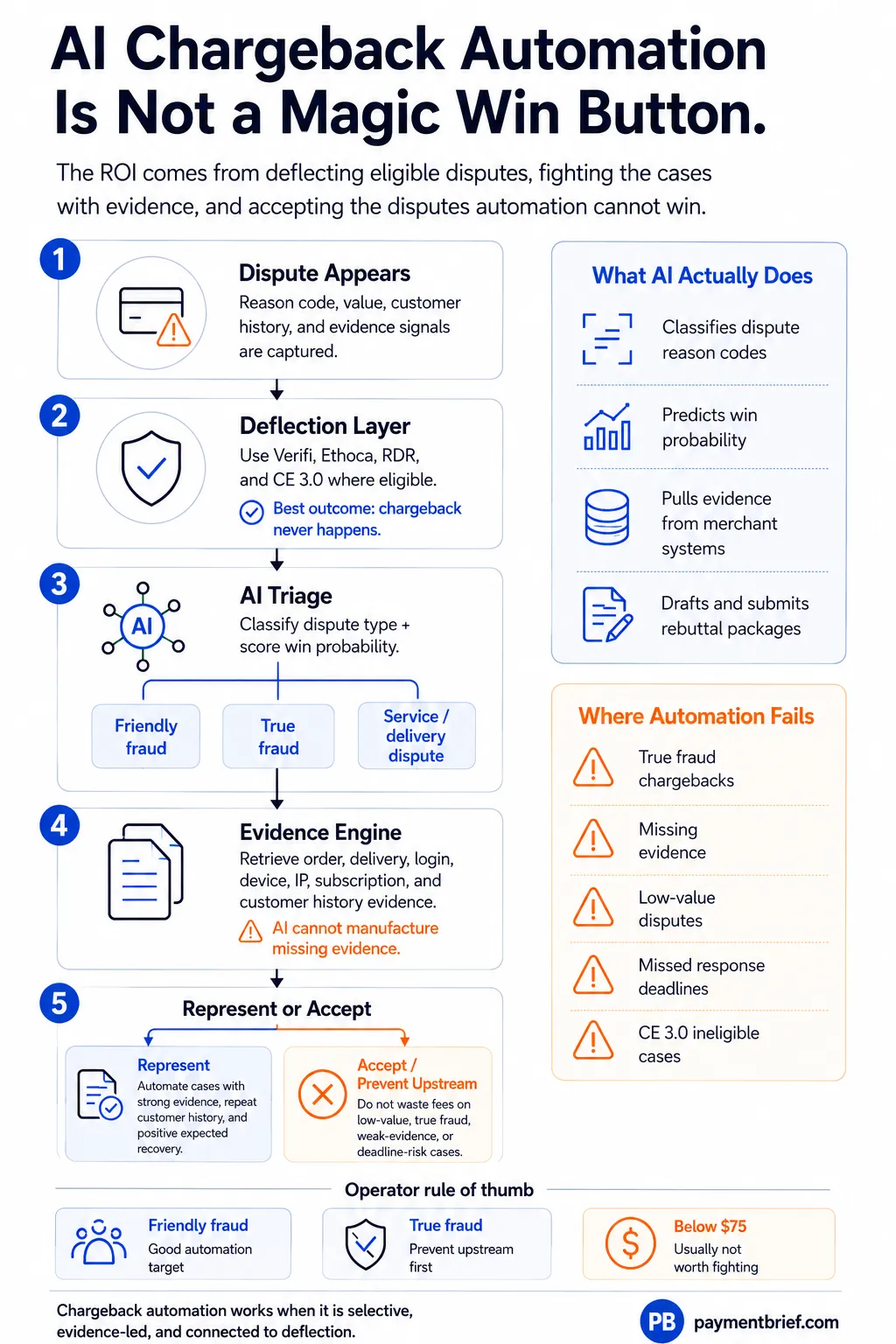
What AI representment actually does
Most operators conflate two distinct tools: dispute deflection and representment automation. They are not interchangeable.
Dispute deflection operates pre-chargeback. When a cardholder contacts their issuer to dispute a transaction, Verifi Order Insight and Ethoca Consumer Clarity push enriched merchant transaction data — itemized receipts, delivery confirmations, subscription terms, logo, customer service contact — directly into the issuer's interface. The issuer can resolve the dispute at that moment without ever issuing a chargeback. Ethoca Consumer Clarity prevents up to 23% of chargebacks on average, and up to 70% in certain verticals (primarily subscription and digital goods). Verifi Order Insight claims up to 70% dispute prevention for eligible transactions. Order Insight and CE 3.0 also share a real-time integration: when a disputed transaction matches at least two data elements — login/account ID, IP address, device ID, or shipping address — against a prior undisputed transaction, the evidence is submitted automatically and the chargeback never files.
Representment automation operates post-chargeback. The chargeback has already been issued, the merchant account has been debited, and the clock is running. AI representment systems do three things in this phase: they classify the dispute by reason code and predict its win probability, they retrieve and assemble the evidence package appropriate to that reason code, and they draft the rebuttal letter and submit the package to the acquirer within the deadline window.
The distinction matters operationally because the tooling, integrations, and cost structures are different. Deflection tools require real-time data feeds — merchant systems must be able to serve up transaction metadata on demand when issuers query. Representment tools need access to order management systems, carrier APIs, login event logs, and fraud platform data to pull the evidence retroactively. Operators who try to solve a representment problem with deflection tools (or vice versa) get the wrong answer.
For a detailed walkthrough of the dispute lifecycle stages and reason code evidence requirements, the chargeback representment guide covers that mechanics layer.
The vendor map
The representment automation market has consolidated and, in Stripe's case, split into two distinct products since this space was last mapped. This vendor map covers the representment-automation layer specifically; for the full operating-model comparison — pre-dispute alert networks, representment automation, and managed recovery as one stack — see Chargeback Management Compared: Alerts, Representment, and Recovery Models.
Stripe now runs two separate products in this space, and conflating them is a mistake. Chargeback Protection is a liability transfer product, not a representment tool: at 0.4% per eligible transaction, Stripe absorbs fraud disputes and reimburses the merchant the disputed amount plus the dispute fee, up to a reported $25,000 annual cap per account (€20,000 in Europe) — a figure not published on Stripe's own marketing pages but consistently reported by several independent sources, so confirm your current limit with Stripe directly. "Product not received" and "not as described" chargebacks are excluded. Smart Disputes, Stripe's newer product, is a genuine representment-automation tool: an AI rules engine builds and submits a tailored evidence packet for eligible disputes automatically before the deadline, and Stripe charges 30% of the disputed amount only on disputes it wins — nothing on disputes it loses. It covers a broader set of reason codes than Chargeback Protection's fraud-only scope. Stripe also integrates Verifi for pre-dispute deflection, including CE 3.0 via Order Insight. For merchants already on Stripe, the practical stack is Verifi deflection first, Chargeback Protection for known fraud exposure, Smart Disputes for what gets through.
Sift Dispute Management uses ML-powered Response Recommendations to automate representment workflows. Sift acquired Chargeback (the company) in 2021 and folded its dispute-automation technology into the Sift platform; its Adyen and PayPal integrations — which let Dispute Management ingest chargeback data and confirm response delivery natively — expanded further in February 2026. The ML layer predicts win probability per dispute and can route low-probability cases to acceptance rather than burning time on unwinnable fights.
Adyen's Disputes API handles chargeback defense — that capability sits under Adyen's dispute-management documentation, not under "Adyen Protect," which is a separate product: Adyen's fraud-scoring risk engine (formerly branded RevenueProtect), unrelated to defending chargebacks. Adyen automatically defends chargebacks that don't require merchant action — for example, fraud chargebacks with an established liability shift, such as 3D Secure transactions — with no manual step needed. Chargebacks that can't be auto-defended require evidence upload through the Customer Area or the Disputes API. The separate Chargeback Uploader lets merchants who process through Adyen but dispute through an external acquirer submit evidence via CSV upload — it doesn't manage those disputes end-to-end, just the upload step. For merchants whose primary acquirer is Adyen, the auto-defense path is the lowest-friction option in the market.
Chargebacks911's Unified Dispute Management System (UDMS) is built around AI-powered automation of the representment workflow. Chargebacks911 has cited a 98% automation figure for UDMS since a 2022 milestone announcement — treat that as a 2022-vintage claim, not a refreshed current benchmark; the company's more recent marketing emphasizes blocking disputes pre-chargeback rather than restating an automation percentage. Chargebacks911 separately operates ResolveLab, a white-label disputes-as-a-service platform built for financial institutions, acquirers, and payment facilitators — it is not a merchant-facing product, and does not itself capture consent data at the point of a merchant's transaction.
Verifi Order Insight (Visa/Verifi) and Ethoca Consumer Clarity (Mastercard) remain the deflection layer, and the vendor figures above for both are unchanged from prior verification. For operators who are not yet on either network, this is the first integration to prioritize — preventing a chargeback is materially cheaper than winning one.
Midigator — now operated as part of Kount (Equifax); midigator.com redirects to kount.com — occupies the analytics-driven end of the market: data-analytics-first (classic ML, not LLM-generated responses), customizable evidence templates, and a focus on dispute segmentation before automation. The 65–80% AI-assisted win-rate figure often quoted alongside Midigator is Kount's general published benchmark, not a proprietary Midigator result — treat it as an industry-wide directional figure rather than evidence unique to this platform.
The win rate math
The two numbers that actually matter here are the ones from the opening: 8.1% across all disputes US merchants receive, versus roughly 54% (Mastercard/Datos Insights, also US-scoped) among disputes merchants choose to contest. Quoting either figure without its denominator — or its geography — is how operators end up with the wrong mental model of what automation can fix.
Manual in-house representment achieves 20–40% win rates on the disputes teams actually fight. AI-assisted platforms reach 65–80% on the disputes they target (Kount/Equifax benchmark). The gap is real — but it describes contested disputes, not the full inbound volume, and it varies sharply by dispute type.
Friendly fraud disputes — where a cardholder disputes a legitimate transaction — are the strongest automation target. The evidence profile is predictable: delivery confirmations, login logs, prior transaction history, behavioral data. Automation systems are good at retrieving structured evidence against a defined template, and the pattern is consistent enough that ML models can estimate win probability before filing while LLMs assemble coherent rebuttal narratives from the raw evidence.
Fraud chargebacks — where a card was genuinely compromised — are a fundamentally different problem, and win rates for them run materially lower than for friendly fraud. The merchant often cannot prove the legitimate cardholder authorized the transaction, because they did not. Automation does not meaningfully improve outcomes here; deploying automated representment against a predominantly fraud-driven dispute mix mostly spends money to lose faster.
High-value transactions draw more scrutiny from issuers and more motivated disputes from cardholders, so win rates fall as transaction value rises, even with a complete evidence package. Automation helps on volume; it does not solve the intrinsic difficulty of high-value dispute defense.
Operators who measure dispute type before buying automation and see that fraud chargebacks dominate their mix should invest in fraud prevention (reducing the chargebacks) before they invest in representment automation (fighting the chargebacks). The AI fraud detection article covers that layer specifically.
LLM vs ML: the hybrid that actually works
No major vendor publishes their model architecture. What is consistent across public documentation, vendor case studies, and operator conversations is the pattern: hybrid is the standard, not the exception.
The ML layer handles structured prediction tasks: dispute classification by reason code, win probability scoring based on available evidence signals, routing decisions (contest vs. accept), and escalation triggers. Classic ML — gradient boosting, decision trees, ensemble models — is better suited to tabular feature scoring than LLMs. It runs faster, is more explainable (relevant when acquirers ask why a case was filed), and produces stable outputs on structured data. Midigator's approach is explicitly data-analytics-driven, which reflects a deliberate architectural choice against LLM-generated responses.
The LLM layer handles natural language tasks: converting raw structured evidence (carrier tracking confirmations, login timestamps, session data) into coherent rebuttal narratives that meet the acquirer's submission format. Assembling a compliant representment letter from a delivery API response, a fraud platform risk score, and IP log data is exactly the type of unstructured synthesis task LLMs do well. The output is auditable and grounded in real data, and it generates far faster than a human analyst — though no vendor discloses a verifiable figure for exactly how much faster.
The rule engines vs ML architecture piece covers the underlying hybrid design in depth; the same structural logic applies to dispute systems. Rules govern action limits (when to accept, when to escalate to pre-arbitration), ML scores the probability distribution, and where natural language output is required, LLMs handle generation. The automation ROI comes from eliminating manual handling for the structured, well-evidenced majority of cases while preserving human review for high-value or complex disputes.
Where automation fails
Network response windows are not what most merchants actually get. Visa's VCR merchant response window is 30 days network-wide, for both the Allocation and Collaboration workflows; Mastercard's Mastercom window is 45 days across all categories. But those are the networks' outer limits, not what acquirers typically enforce — acquirers routinely impose tighter internal deadlines to leave themselves time to forward a case within the network's window. Adyen, for example, cut its merchant-facing deadline to 9 days for disputes on payments processed locally in the US and Canada, and 18 days elsewhere, effective July 2025. Systems that wait for evidence retrieval to complete before initiating submission will miss deadlines against a deadline that tight on a portion of their case volume. Confirm the deadline your own acquirer enforces — don't plan automation timing around the network figure alone.
CE 3.0 has a specific evidence constraint that automation cannot solve retroactively: it requires two prior undisputed transactions that are 120 to 365 days older than the disputed transaction. For merchants with short customer lifespans or low repeat purchase rates, the required prior transactions simply do not exist for a material share of disputes. Systems that flag CE 3.0 eligibility without checking the prior-transaction condition generate false confidence.
Dispute type scope is another ceiling. CE 3.0 applies only to Visa reason code 10.4 (Other Fraud, Card-Absent). Automation tools that market CE 3.0 benefits to merchants with dispute mixes heavy in 13.x (consumer disputes, including 13.1 Item Not Received) or Mastercard codes are describing a capability that does not apply to those cases — there is no documented Mastercard equivalent to CE 3.0.
Evidence availability gaps kill win rates before the AI layer gets involved. If the merchant's order management system does not retain structured delivery data, if carrier tracking webhook integrations failed, or if login event logs are not retained for long enough, the evidence retrieval step returns empty and the ML model is scoring on signal-poor features. Automation does not manufacture evidence — it retrieves and assembles it. Gaps in data retention infrastructure translate directly to lost cases.
Network tokens improve authorization rate data quality and reduce fraud chargebacks at the source, but they do not retroactively improve evidence for existing disputes. For the longer-term view on token infrastructure and dispute prevention, the network tokens article and the authorization optimization piece both address upstream prevention levers.
CE 3.0 auto-qualification changed the calculus — and gained a fee
Visa Compelling Evidence 3.0 launched in April 2023. The October 17, 2025 change that matters for operators is auto-qualification: merchants on Visa Secure and Visa Data Only across all regions now qualify for CE 3.0 automatically, without manual filing, for Visa reason code 10.4 disputes.
Before October 2025, CE 3.0 was available but required explicit merchant opt-in and manual evidence submission through Verifi. That friction suppressed adoption — many merchants who had qualifying prior transaction data never received the benefit because the operational burden to claim it exceeded the willingness to act case by case.
Auto-qualification means that for eligible disputes, the CE 3.0 evidence check happens automatically. If the merchant has the two required prior undisputed transactions (same cardholder, 120–365 days old), the dispute is resolved in the merchant's favor at the issuer level — the chargeback never progresses to chargeback representment. The deflection happens earlier in the lifecycle, at lower operational cost than a representment filing.
What has not been widely reflected in coverage of CE 3.0 yet: from April 17, 2026, Visa added a fee for each successful CE 3.0 qualification. No Visa document has published the amount as of this review — confirm the current figure with your acquirer before modeling CE 3.0 as a purely free deflection channel. It still does not count toward VAMP thresholds, which is what keeps it valuable for threshold management even with a fee attached.
The strategic implication: merchants on Visa Secure who have not audited their CE 3.0 eligibility rates are leaving automatic dispute resolution on the table, minus a per-qualification cost that needs to be modeled once the fee amount is confirmed. The first operational task is to determine what percentage of your Visa 10.4 disputes have qualifying prior transaction pairs.
VAMP: the merchant threshold dropped and the fee scope widened
Visa retired VDMP and VFMP on March 31, 2025 and consolidated them into VAMP (Visa Acquirer Monitoring Program), effective April 1, 2025, with the TC40+TC15/TC05 ratio formula taking effect June 1, 2025.
VAMP enforcement at the Excessive level began October 1, 2025, at the acquirer level: $8 per transaction for acquirers above the Excessive threshold. Above Standard enforcement, also acquirer-level, began January 1, 2026: $4 per transaction. The monitoring qualification floor is 1,500 combined fraud-and-dispute transactions per month for AP, Canada, EU, and the US; CEMEA runs a materially lower floor of 150 events and USD 75,000/month, so a small CEMEA merchant can enter monitoring at a fraction of the volume that would trigger it elsewhere.
Two changes landed on the same date, April 1, 2026, and both matter for operators reading this now. First, the merchant Excessive threshold dropped from 2.2% to 1.5% for AP, Canada, the EU, and the US (LAC was already at 1.5%; CEMEA remains at 2.2%). Second, the Excessive fee started billing merchants directly, not only their acquirer — a merchant crossing from "compliant at 2.2%" to "Excessive at 1.5%" now faces a direct per-transaction cost rather than only a pass-through set by acquirer contract.
The mechanism that directly affects automation ROI: RDR-resolved pre-disputes do not count toward VAMP ratios, and neither do CE 3.0 resolutions (contingent on data-extract timing). This means dispute prevention tools — Verifi Rapid Dispute Resolution and CE 3.0 qualification — are not just reducing dispute volume; they are keeping resolved disputes out of the ratio calculation that now determines direct merchant fee exposure, not just acquirer standing.
The upstream fraud prevention investment also matters here. Velocity checks and behavioral fraud signals that reduce fraud chargebacks reduce the VAMP ratio input — the same disputes that automation struggles to win are the ones that count against the threshold. Preventing fraud chargebacks through detection and blocking is the most efficient path to threshold management.
What operators should actually do
Instrument your dispute mix before buying automation. Break out your chargebacks by reason code, dispute type (fraud vs. friendly fraud vs. service dispute), and transaction value tier. If your fraud chargeback share dominates your mix, the ROI case for representment automation is weak. If friendly fraud dominates, automation should pay for itself quickly.
CE 3.0 is nearly free if you are already on Visa Secure — model the new fee, don't assume it's zero. Audit your Verifi Order Insight integration and transaction data retention first. Auto-qualification since October 2025 means your existing infrastructure may already be deflecting eligible Visa 10.4 disputes; confirm your current acquirer-quoted qualification fee before treating the channel as costless.
Know your VAMP position, including the new direct-to-merchant fee exposure. Map your current dispute ratio against the 1.5% threshold now in effect for AP/Canada/EU/US (2.2% in CEMEA, with its own lower monitoring floor). Since April 1, 2026, breaching Excessive means a direct per-transaction fee to you, not just your acquirer. Identify how many disputes per month are resolved via RDR or CE 3.0 and thus excluded from the ratio.
Fix evidence retention before deploying automation. Automation systems retrieve evidence from your data sources — carrier APIs, order management systems, login event logs, fraud platform data. If those sources have gaps, the automation layer has nothing to work with. Audit your evidence availability by dispute type before signing vendor contracts.
Separate the deflection and representment vendor decisions, and don't confuse a vendor's adjacent products. Verifi Order Insight and Ethoca Consumer Clarity operate pre-chargeback. Representment platforms (Midigator/Kount, Chargebacks911 UDMS, Sift Dispute Management, Stripe Smart Disputes) operate post-chargeback. Adyen Protect (fraud scoring) is not the same product as Adyen's Disputes API (chargeback defense), and Stripe Chargeback Protection (fraud liability transfer) is not the same product as Stripe Smart Disputes (representment automation) — read a vendor's own current documentation before assuming what a familiar product name still does.
Don't automate every low-value dispute reflexively. Below some transaction-value floor, the expected recovery on a dispute is negative once acquirer fees and platform costs are counted — where exactly that floor sits depends on your fee schedule and platform pricing, so calculate it for your own stack rather than importing a number from vendor marketing. The operational discipline to accept strategically — rather than fight everything — is where operators recapture time and budget for the cases that move the number.
The $33.8B in global chargeback exposure is not going away. What changed in the past several months is the tooling on offer (Stripe split its dispute product in two; Midigator folded fully into Kount), the VAMP stakes (a direct merchant fee, not just an acquirer pass-through), and the CE 3.0 economics (a new qualification fee alongside the auto-qualification benefit). The operators who see real improvement from automation in 2026 are the ones who enter it with a clean data picture, a segmented dispute mix, and a clear, current understanding of what each vendor's product actually does today — not what it did, or what a generic "AI tools" claim implied, a year ago.
Sources & methodology (16)
$33.8 billion global chargeback value in 2025, across 261 million transactions
Corroborated across two independent secondary summaries of the Mastercard/Datos Insights research; this figure relies on those secondary summaries rather than the primary report directly.
Checked:
US merchants win 8.1% of all disputes received outright; among disputes merchants choose to contest (represent), the win rate is 54%
The 8.1% figure is the win rate across all disputes received, not a representment-specific rate — most of those disputes were never contested. The contested/representment win rate in the same research is 54%. Both figures are explicitly scoped to US merchants: 'Per Mastercard's funnel breakdown... US merchants win just 8.1% of all disputes outright, even though they win 54% of the ones they fight.'
Checked:
Chargebacks911's 2026 Chargeback Field Report, in its representment section, states that factoring in the percentage of wins escalated to a second-cycle chargeback, 'the average respondent’s net recovery rate averages an alarming 10.7% of cases'. The report gives no first-cycle win-rate figure there; it uses 43.8% for merchants' estimated friendly-fraud share of their chargebacks
10.7% net recovery rate (survey, no stated geography)
Chargebacks911's separate chargeback-statistics page gives two different contested-win figures for the same measure — 44.6% in its headline, unattributed, and 43.8% attributed to the Field Report, which uses that number for friendly-fraud share instead. Because the source is inconsistent with itself, this article does not carry a Chargebacks911 win rate.
Checked:
Manual in-house representment achieves roughly 20-40% win rates; AI-assisted platforms report 65-80% on the disputes they target
Widely repeated industry figures rather than a single primary study; directional, not a guaranteed outcome for any specific dispute mix.
Checked:
In 2026, every dollar lost to fraud is expected to cost US merchants $5.13, a 52.6% increase versus 2020
Replaces an earlier '$3.75-$4.61' figure from this article, which was an older LexisNexis edition (roughly 2024/2025 vintage) superseded by the 2026 figure.
Checked:
Stripe Chargeback Protection: 0.4% per eligible transaction, fraud disputes only; reimburses disputed amount plus dispute fee, up to a $25,000 (or €20,000 in Europe) annual reimbursement cap per account
The 0.4% fee and fraud-only scope are confirmed on Stripe's own announcement, which does not itself state a cap. The $25,000 annual cap (€20,000 in Europe) is not published on Stripe's public marketing pages (newsroom, docs.stripe.com/disputes, and stripe.com/pricing do not state it) but is reported consistently, with matching specific figures in both currencies, across three independent secondary sources (justt.ai, chargeback.io, cardfellow.com), one of which states it is quoting Stripe's account terms directly. Treat the exact figure as needing reconfirmation against your own Stripe account terms, since it is not independently visible in Stripe's public documentation.
Checked:
Stripe Smart Disputes: AI rules engine automates evidence assembly and submission for eligible disputes; fee is 30% of the disputed amount, charged only on disputes Stripe wins
This is a materially different, broader-scope representment-automation product than Chargeback Protection and belongs in the vendor map.
Checked:
Sift acquired Chargeback (the company) in 2021; Sift Dispute Management's Adyen and PayPal integrations expanded in February 2026
Checked:
Adyen Protect is Adyen's fraud-scoring risk engine (formerly RevenueProtect) and is a separate product from chargeback defense; automatic chargeback defense and the Disputes API sit under Adyen's dispute-management docs, not under Protect
Checked:
Midigator is now operated as part of Kount (Equifax); midigator.com redirects (301) to kount.com
This is Kount's general published industry benchmark, shared across Kount's product line, not data unique to Midigator.
Checked:
Chargebacks911 ResolveLab is a white-label disputes-as-a-service platform built for financial institutions, acquirers, and payment facilitators, not a merchant-facing tool
Checked:
Chargebacks911 UDMS: 98% automation with AI-powered robotics — a 2022 milestone announcement, not a current benchmark
Checked:
CE 3.0 auto-qualification launched October 17, 2025 for Visa Secure and Visa Data Only merchants; a per-qualification fee (amount undisclosed) was added April 17, 2026
Visa's own Merchant Business News Digest page states: 'Effective 17 April 2026, Visa will introduce an associated fee for successful qualifications' (October 2025 digest entry). No fee amount is published there.
Checked:
VAMP replaced VDMP and VFMP effective April 1, 2025 (ratio formula effective June 1, 2025); Excessive enforcement fees ($8/transaction) began October 1, 2025 at the acquirer level; Above Standard ($4/transaction) began January 1, 2026; merchant Excessive threshold dropped from 2.2% to 1.5% in AP/Canada/EU/US on April 1, 2026, the same date the Excessive fee began billing merchants directly rather than only acquirers; CEMEA remains at 2.2% with a lower monitoring floor (150 events and USD 75,000/month, vs. 1,500 events/month elsewhere)
Checked:
Verifi Order Insight and Compelling Evidence 3.0 share a real-time integration: matching login/device/IP/shipping data from prior undisputed transactions is submitted automatically through Order Insight's live communication channel
Checked:
Ethoca Consumer Clarity prevents up to 23% of chargebacks overall, up to 70% in some industries; Verifi Order Insight claims up to 70% dispute prevention for eligible transactions
Vendor-published figures for the respective vendor's own tool, not independently audited.
Checked:
Source types explained in our Methodology.
 By Shaun Toh · Director, Digital Payments · Razer