Wave launched in Dakar 2019; USD 200M Series A at USD 1.7B valuation in 2021; expansion to Côte d'Ivoire and beyond
USD 200M Series A, Stripe-led, September 2021
Checked:
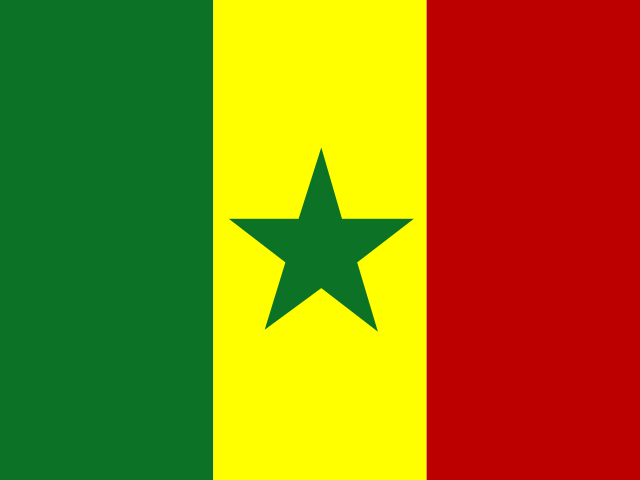
Senegal is Wave's home market — Wave launched in Dakar in 2019 and reached 2M+ daily actives on 18M population. First oil production began March 2024.
Top payment methods
Shares are approximate and may overlap (e.g. wallets sitting on cards) or use different denominators (e-commerce vs POS). See FAQ + sources below for context.
Infrastructure
The active payment categories in Senegal — their role, adoption, and market position.
Instant account-to-account fund transfers settled in seconds via a national rail.
Credit and debit card payments processed over Visa, Mastercard, and local networks.
Mobile-first stored-value wallets enabling QR, NFC, and in-app checkout.
Direct debit and credit transfers between bank accounts for high-value settlements.
Instalment-based lending at checkout; growing fast across Southeast Asia.
Physical currency; still significant in markets with lower banking penetration.
Analytics
Estimated share of consumer payment volume by method.
Estimates based on reported transaction volumes. Data as of May 15, 2026. Percentages rounded to nearest whole number.
Rail Profile
Senegal's national real-time payments rail — enabling instant, 24/7 account-to-account transfers.
How payments flow
Mobile money (Wave, Orange Money, Free Money)
Real-time · ~1 sec
No intermediary PSP float. Settled instantly, 24/7. Near-zero MDR for merchants.
Card Payment
Auth ~2–3 sec · T+1 settlement
3DS2 authentication on CNP. MDR 1.0%–2.0% (debit) or 2.0%–3.5% (credit). Issuer holds chargeback liability.
E-Wallet (Mobile Wallet)
Instant · local rail
Mobile wallet backed by local instant payment rail. MDR 0–1.5%.
Deep Dive
Senegal is Wave's home market. Wave launched in Dakar in 2019 — its first market anywhere — and reached 2M+ daily active users on a population of approximately 18 million by 2023, a penetration rate that rivals M-Pesa in Kenya relative to population. Orange Money holds the largest registered-user base among Senegalese telco wallets, but Wave leads on daily activity and consumer mindshare among smartphone-using urban consumers. The country sits within the eight-country WAEMU zone regulated by the BCEAO, whose headquarters is in Dakar — making Senegal not just a member country but the regulatory capital of Francophone West Africa's monetary union. Economically, Senegal is accelerating: the Sangomar oil field (operated by Woodside Energy) achieved first production in June 2024, and the Tortue LNG project (BP/Kosmos Energy) has come online, projecting ~6% GDP growth through 2025 as hydrocarbon revenues flow to the government for the first time.
Wave was founded in 2017 by Lincoln Quirk and Drew Durbin (both YC alumni), incorporated in the United States, and chose Dakar as its first launch city in 2019. The founding market insight was that Orange Money and Tigo Cash were charging 1–2% on P2P transfers — in a market where mobile money P2P is a daily-use utility — and that 0% fees combined with a superior smartphone UX would structurally displace incumbents faster than any incremental product improvement could.
The product: Wave's core is P2P transfer at 0% fee. The app is smartphone-native (not USSD), handles merchant QR-code payments, bill payments, and airtime. Wave issues a physical Visa debit card that users can take to any ATM or Visa-accepting merchant for cash or card payment — a key differentiator since it removes dependency on Wave agents for cash access. Merchant acceptance is QR-based, keeping the hardware and setup cost low for small merchants.
Scale: Wave reached 2M+ daily active users in Senegal by 2023 on an 18-million population — that density approaches M-Pesa-level household penetration in Kenya. In September 2021, Wave raised a USD 200M Series A led by Stripe at a USD 1.7B valuation, the largest African startup Series A at the time. Capital funded expansion into Côte d'Ivoire (2021), Mali, Burkina Faso, and Uganda. The Senegal market remains Wave's deepest and most operationally mature.
Orange Money Senegal is operated by Orange Senegal (Orange Group, Paris-listed). Orange is Senegal's largest telco by subscriber base, and Orange Money launched years before Wave — giving it the largest registered user base. Product coverage includes P2P transfers, merchant payments, bill payments, airtime, and international remittance corridors relevant to Senegal's large diaspora (particularly the Dakar–Paris corridor). Orange Money charges approximately 1–2% on P2P, a fee structure Wave has made visible and painful in urban markets.
Free Money (Yas) is the wallet product of Free Senegal (Iliad Group subsidiary), Senegal's third mobile network operator. Free entered Senegal in 2017 and has built a meaningful mobile subscriber base, particularly among price-sensitive consumers who respond to Free's aggressive tariff positioning. Free Money's wallet share is smaller than Orange Money and Wave, but it is relevant for operators wanting comprehensive Senegalese method coverage.
Wari originated as a Tigo (telco) product before being spun off as an independent domestic and international money transfer network. Joni Joni operates similarly — an agent-network cash-in/cash-out transfer service used primarily for domestic and diaspora remittances, particularly to lower-income and rural segments. Both networks predate smartphone-based mobile money and were built on feature-phone and agent-mediated access models.
Their relevance has contracted sharply in urban Dakar: Wave, Orange Money, and Free Money handle the overwhelming majority of digital payment volume in cities. Wari and Joni Joni remain operationally relevant for two specific cases: rural disbursements to consumers who do not use smartphone-based wallets, and diaspora cash-out in peri-urban and rural areas where Wave's agent density is lower. Operators running G2P disbursement programmes, insurance payouts, or agricultural payments to rural Senegalese populations should evaluate Wari and Joni Joni for last-mile cash-out capability rather than excluding them on the assumption that Wave covers all geographies.
The BCEAO — headquartered in Dakar — is the central bank for the eight-country WAEMU zone and issues electronic money issuer licences under WAEMU Instruction No. 008/2002-SP/BCEAO. For Senegal specifically, the national regulatory direction is the DRSSMP (Direction de la Réglementation et de la Supervision des Systèmes et Moyens de Paiement), operating under BCEAO authority. The shared BCEAO framework means consistent legal architecture and the same XOF currency across Senegal, Côte d'Ivoire, Mali, Burkina Faso, Benin, Niger, Togo, and Guinea-Bissau — but country-specific licensing is still required for each market. A Senegal approval does not automatically extend to CI or other WAEMU members. See the Côte d'Ivoire guide for the parallel regulatory discussion in the WAEMU zone's largest economy.
Senegal's economic trajectory changed structurally in 2024. The Sangomar oil field (Woodside Energy, operator) achieved first oil production in June 2024 — Senegal's first commercial crude production after years of exploration and development. The Greater Tortue Ahmeyim LNG project (BP/Kosmos Energy, Phase 1) delivered first LNG in early 2025. Combined, these two projects move Senegal from an aid-dependent frontier economy to an active hydrocarbon exporter, with the IMF projecting approximately 6% GDP growth in 2024–2025 driven by export revenues.
For payment infrastructure, the implications are direct: rising government fiscal capacity for digital financial infrastructure investment, growing formal-sector employment in oil services and related industries, and heightened fintech investor attention. Senegal's political backdrop matters here too — the country has maintained stable democratic governance with peaceful presidential transitions in 2012, 2019, and March 2024, a track record that distinguishes it from several regional peers and makes long-term investment positioning more predictable.
Senegal's PSP ecosystem for foreign operators is relatively straightforward. Flutterwave and Paystack (Stripe-owned) cover Senegal as part of their pan-African gateway products, handling Wave, Orange Money, Free Money, and Visa/Mastercard card acceptance via a single integration — the standard route for operators with multi-country Africa coverage needs. Neither a CinetPay-equivalent CI-native gateway nor a direct BCEAO-licensed gateway is strictly required if the operator is already running a pan-African PSP stack. For operators entering Senegal specifically, direct Wave merchant API integration is feasible and documented; similarly for Orange Money and Free Money merchant APIs. For cross-border B2B AR or supplier disbursement flows in Francophone West Africa, the Julaya B2B platform covers both Senegal and CI.
For operators building WAEMU coverage, the natural two-market starting point is Côte d'Ivoire and Senegal — the zone's two largest economies, both Wave-accessible, both XOF-denominated. Côte d'Ivoire is the larger market by GDP (~USD 70B vs Senegal's ~USD 30B) with CinetPay as the CI-native gateway option; Senegal is Wave's deepest market and the oil-growth story. For broader West Africa, Ghana is the Anglophone parallel (MTN MoMo-dominant, BoG-regulated, GHS-denominated), and Nigeria is the structural contrast — bank-led, NIBSS NIP-driven, 220M population.
Wave's success in Senegal came from attacking two things simultaneously: price and user experience. Orange Money and Tigo Cash (the incumbents) were charging 1–2% on P2P transfers — Wave launched at 0%. That alone would have attracted price-sensitive users, but Wave also built a smartphone-first app in a market where smartphone penetration was growing rapidly among urban consumers, versus the USSD-based interfaces of the incumbents. Wave added a physical Visa card for ATM cash withdrawals, removing the need to visit an agent for cash-out and extending the wallet's usefulness beyond digital-only scenarios. Launched in 2019 with Dakar as the first city, Wave scaled to 2M+ daily active users in Senegal by 2023 — extraordinary penetration on an 18-million population. The combination of zero P2P fees, modern UX, and the Visa card created a product that was more useful and cheaper than anything incumbents offered.
The BCEAO (Banque Centrale des États de l'Afrique de l'Ouest) is the shared central bank for the eight-country WAEMU zone — Benin, Burkina Faso, Côte d'Ivoire, Guinea-Bissau, Mali, Niger, Senegal, and Togo — and is headquartered in Dakar. The BCEAO issues the electronic money issuer licence framework under WAEMU Instruction No. 008/2002-SP/BCEAO. For Senegal specifically, the national regulatory direction is the DRSSMP (Direction de la Réglementation et de la Supervision des Systèmes et Moyens de Paiement), which operates under BCEAO authority. A licence approved for Senegal does not automatically cover other WAEMU countries — operators need country-specific approval in each market they enter. The shared framework means consistent legal architecture and the same currency (XOF), but country-by-country presence and approval is still required in practice.
The Sangomar oil field, operated by Woodside Energy, achieved first production in March 2024 — Senegal's first commercial crude oil production. The Tortue LNG project (BP/Kosmos Energy Phase 1) reached first production in early 2025. These two projects have moved Senegal from a frontier oil explorer to an active hydrocarbon producer, with GDP growth projected around 6% through 2025 driven by hydrocarbon export revenues. For payment infrastructure, the practical effects are: rising government revenues creating digital payment investment capacity, growing formal-sector employment in oil services creating more banked and digitally-active consumers, and heightened international investor attention to Senegal's fintech ecosystem. Senegal has also maintained a record of stable democratic governance — peaceful presidential power transitions in 2012, 2019, and 2024 — which makes it more attractive for long-term fintech investment than regional peers where political stability is less predictable.
Wari was originally founded as a Tigo (telco) product and later spun off as an independent domestic money transfer network; Joni Joni operates similarly as a domestic and diaspora cash transfer service. Both predate the smartphone-based mobile money era and were built on agent-network cash-in/cash-out models primarily serving lower-income and rural consumers without smartphones. Their relevance has declined sharply in urban Dakar — Wave, Orange Money, and Free Money have absorbed most urban digital payment volume. Wari and Joni Joni remain relevant for two specific operator use cases: disbursements to rural or unbanked consumers who do not use smartphone-based wallets, and diaspora remittance cash-out in rural and peri-urban areas where Wave agent density is lower. Operators serving the full Senegalese population distribution — not just urban smartphone users — should treat these networks as cash-out infrastructure for the tail of unbanked recipients.
Senegal and Côte d'Ivoire share the same currency (XOF), the same regulatory framework (BCEAO), and the same dominant PSP stack (Flutterwave, Paystack). The structural difference is Wave's position: Senegal is Wave's home market where Wave launched in 2019 and achieved dominant daily-active-user penetration; Côte d'Ivoire is Wave's second major market, launched 2021, where Orange Money and MTN MoMo still hold larger registered-user bases. Côte d'Ivoire is the larger economy (~USD 70B GDP vs Senegal's ~USD 30B) and the larger e-commerce opportunity. Senegal has a more Wave-native fintech ecosystem and the emerging hydrocarbon-driven GDP acceleration. Operators targeting WAEMU typically start with CI (larger economy, broader PSP coverage via CinetPay) or Senegal (Wave-native ecosystem, oil-driven growth), and use the same XOF gateway integration for both markets.
Wave launched in Dakar 2019; USD 200M Series A at USD 1.7B valuation in 2021; expansion to Côte d'Ivoire and beyond
USD 200M Series A, Stripe-led, September 2021
Checked:
BCEAO electronic money issuer regulatory framework and WAEMU payment systems; BCEAO headquarters in Dakar
Checked:
Senegal GDP, population, GDP per capita
Checked:
Senegal economic outlook, GDP growth projection, hydrocarbon revenue context
Checked:
Sangomar oil field first oil production achieved June 2024 (Woodside Energy operator)
First oil June 2024
Checked:
GSMA mobile money data and operator statistics for West Africa / Senegal
Checked:
Orange Senegal — telco operator, Orange Money Senegal product
Checked:
FSD Africa financial sector development context for Senegal
Checked:
Source types explained in our Methodology.
Compliance
Payments in Senegal are governed by BCEAO (Banque Centrale des États de l'Afrique de l'Ouest). PSPs require a BCEAO electronic money issuer licence under WAEMU framework licence to operate.
BCEAO electronic money issuer licence under WAEMU framework issued by BCEAO (Banque Centrale des États de l'Afrique de l'Ouest).
FATF-compliant AML/CFT obligations apply. KYC, transaction monitoring, and suspicious activity reporting required for all licensed PSPs.
Payment transaction data subject to national data protection laws. Cross-border data transfers require appropriate safeguards.
Economics
Typical MDR ranges for merchants accepting payments in Senegal. Rates vary by acquirer, card type, and merchant category.
| Payment Type | Typical MDR Range |
|---|---|
| Credit Card | 2.0%–3.5% |
| Debit Card | 1.0%–2.0% |
| E-Wallet | 0%–1.5% (Wave 0% P2P; Orange/Free 1–2%) |
| Real-Time Payment | 0.00% – 0.10% |
Rates are indicative and subject to change. Verify current rates with your acquirer or PSP.
Ecosystem
Payment service providers with confirmed Senegal market support. Not a ranking.
Wave (direct)
Payment services provider operating in this market.
Orange Money (direct)
Payment services provider operating in this market.
Free Money (direct)
Payment services provider operating in this market.
Wari
Payment services provider operating in this market.
Joni Joni
Payment services provider operating in this market.
Paystack
Stripe-owned; dominant Nigerian e-commerce gateway with card, bank transfer, and USSD coverage.
Flutterwave
Pan-African payments infrastructure; 34+ markets; strong cross-border and B2B settlement.
Intelligence
Analysis and deep-dives related to Senegal payments.
M-Pesa has grown from a closed-loop Kenyan wallet to a multi-country network with interoperability mandates and API access. What operators need to know.
SWIFT gpi improved speed and transparency, but bilateral real-time rail links and project Nexus are challenging its dominance on key corridors.
Last updated: May 15, 2026