Ghana mobile money transactions reached GH¢518.4 billion in December 2025 (highest monthly figure ever); 982 million transactions
GH¢518.4B / 982M txns (Dec 2025)
Checked:
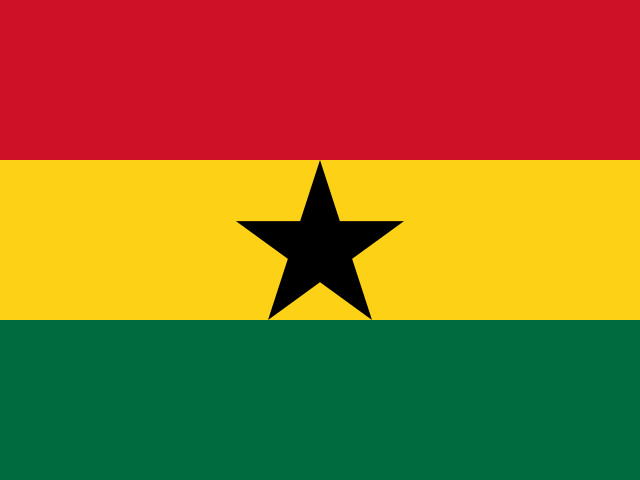
Ghana is West Africa's clearest telco-led mobile money market: MTN MoMo holds ~73% of active accounts and Telecel Cash (ex-Vodafone Cash) ~23%, with mobile money dwarfing the bank rail. GhIPSS Instant Pay clears roughly one-seventh of MoMo volume.
Top payment methods
Shares are approximate and may overlap (e.g. wallets sitting on cards) or use different denominators (e-commerce vs POS). See FAQ + sources below for context.
Infrastructure
The active payment categories in Ghana — their role, adoption, and market position.
Instant account-to-account fund transfers settled in seconds via a national rail.
Credit and debit card payments processed over Visa, Mastercard, and local networks.
Mobile-first stored-value wallets enabling QR, NFC, and in-app checkout.
Direct debit and credit transfers between bank accounts for high-value settlements.
Instalment-based lending at checkout; growing fast across Southeast Asia.
Physical currency; still significant in markets with lower banking penetration.
Analytics
Estimated share of consumer payment volume by method.
Estimates based on reported transaction volumes. Data as of August 24, 2026. Percentages rounded to nearest whole number.
Rail Profile
Ghana's national real-time payments rail — enabling instant, 24/7 account-to-account transfers.
How payments flow
MTN MoMo / Telecel Cash (telco-led) + GhIPSS Instant Pay (bank rail)
Real-time · ~1 sec
No intermediary PSP float. Settled instantly, 24/7. Near-zero MDR for merchants.
Card Payment
Auth ~2–3 sec · T+1 settlement
3DS2 authentication on CNP. MDR 0.5%–2.0% (debit) or 2.0%–3.5% (credit). Issuer holds chargeback liability.
E-Wallet (Mobile Wallet)
Instant · local rail
Mobile wallet backed by local instant payment rail. MDR 0–1.5%.
Deep Dive
Ghana is West Africa's clearest telco-led mobile money market — and a structural mirror of Kenya's M-Pesa model rather than Nigeria's bank-led NIBSS NIP pattern. MTN Mobile Money (MoMo) holds approximately 73% of the mobile money customer base with Telecel Cash (formerly Vodafone Cash) at 23%, AT Money (formerly AirtelTigo Money) at 3%, and Zeepay, G-Money, and GhanaPay jointly holding the remaining ~1%. Total mobile money transactions reached GH¢518.4 billion in December 2025 alone — the highest monthly figure ever recorded — across 982 million transactions. Full-year 2025 mobile money volume reached GH¢4.54 trillion, with 26.7 million active accounts on a 34-million population. The bank-led counter is GhanaPay (operated by GhIPSS, a wholly-owned subsidiary of Bank of Ghana), but GhIPSS Instant Pay processes only GH¢73.3 billion monthly — approximately one-seventh of mobile money volume.
The structural story for foreign operators: Ghana looks like Kenya at the consumer payment layer. Telco-operated mobile wallets with agent networks dominate; cards are small (~25% penetration); bank-led rails are secondary infrastructure. The contrast with Nigeria (West Africa's other major payment market) is clean — Nigeria's high banking penetration and NIBSS NIP dominance produced a bank-led payment landscape, while Ghana's lower banking penetration at MoMo's 2009 launch let the telco model capture the market opportunity. This Ghana–Nigeria contrast is the cleanest West African parallel to the Kenya–South Africa structural mirror.
MTN MoMo is operated by MTN Ghana, part of the MTN Group (JSE/NYSE-listed pan-African telco). Launched in 2009 as one of the earliest African telco-driven mobile money rollouts after Kenya's M-Pesa, MoMo has grown to dominate Ghanaian consumer payments. The product set:
Market share: MTN MoMo holds ~73% of the mobile money customer base as of 2025. Telecel Cash (formerly Vodafone Cash — Vodafone Ghana was rebranded to Telecel Ghana as part of Telecel Group's countrywide rebrand, completed by early 2024) holds ~23%. AT Money (formerly AirtelTigo Money, following AirtelTigo's 2023 rebrand to AT) holds ~3%. Zeepay, G-Money, and GhanaPay jointly hold the remaining ~1%. This concentration is structurally similar to Kenya's M-Pesa dominance — once the network effects and agent network reach critical mass, displacing the leader becomes extremely difficult.
Volumes: December 2025 alone saw GH¢518.4 billion in mobile money transactions across 982 million transactions — a 10% month-over-month increase from November's GH¢481 billion. The annual figure for 2025 reached GH¢4.54 trillion (roughly USD 380+ billion at year-end exchange rates).
For operators: integration with MTN MoMo for merchant acceptance is the standard for any Ghanaian consumer-facing checkout. MoMo offers a direct merchant API (Pay-with-MoMo) with developer documentation; the major local PSPs (Hubtel, Paystack Ghana, Flutterwave Ghana, ExpressPay) all include MoMo acceptance in their gateway products.
The market is essentially a near-monopoly under MTN with a meaningful #2 (Telecel Cash) and a long tail of smaller players that haven't reached operational scale.
GhIPSS (Ghana Interbank Payment and Settlement Systems) is Ghana's bank-led payment infrastructure organisation, a wholly-owned subsidiary of Bank of Ghana. GhIPSS operates several critical payment system components:
GhanaPay's competitive positioning: Launched in 2022 as the banks' strategic response to mobile money dominance. Product features include money transfers, bill payments, airtime, merchant payments, and MyGhanaPay Savings — which pays quarterly interest on end-of-day balances. The interest-bearing savings feature is a structural differentiator from MoMo (which typically does not pay interest on standard wallet balances), giving GhanaPay a clear positioning angle.
The reality of bank rail adoption: Despite bank backing and the interest incentive, GhanaPay and GhIPSS Instant Pay volumes remain a fraction of mobile money — GhIPSS Instant Pay processed approximately GH¢73.3 billion in December 2025 versus MoMo's GH¢518.4 billion (about 1/7). The network effects of MoMo's agent network and consumer mindshare have been difficult for the banking sector to displace.
For operators: GhanaPay acceptance is worth offering for the banked segment of Ghanaian consumers, but should be planned as complementary infrastructure rather than the primary checkout method. MoMo + cards is the standard stack; GhanaPay is the optional bank-aligned addition.
Ghanaian card penetration sits at approximately 25% of adults — small relative to mobile money but growing. Visa and Mastercard dominate; GhIPSS operates GH-Link as the domestic card switching infrastructure for interbank card transactions. There is no major standalone domestic card scheme (unlike Egypt's Meeza or Saudi Arabia's Mada).
MDR for card transactions runs 2.0-3.5% for credit and 0.5-2.0% for debit, with foreign-card cross-border fees adding to that base. Cards are most relevant for higher-value purchases, international flows, hotels, restaurants, and specific merchant categories — not for daily payments which are dominated by MoMo.
Ghanaian e-commerce in 2024 was small (~USD 2B) but growing rapidly. The payment mix:
For operators entering Ghanaian e-commerce, the integration priority is MoMo (via Hubtel or direct MTN API), cards via Hubtel/Paystack Ghana/Flutterwave, and COD support for verticals where consumer preference still demands it.
Bank of Ghana has historically maintained a restrictive posture on cryptocurrency, with periodic advisories against crypto trading. There is no licensed crypto-asset service provider regime as of 2026, though BoG has been exploring a central bank digital currency (the e-Cedi) through pilot programs. Operators with crypto-on-ramp ambitions in Ghana should treat the regulatory environment as restrictive and consult local counsel.
The e-Cedi pilot has been one of Africa's more advanced CBDC initiatives, with BoG conducting retail and merchant trials, though full national rollout has been pushed back multiple times.
Bank of Ghana (BoG) is the central bank and the prudential + conduct regulator for payment activity in Ghana. The relevant legislative framework is the Payment Systems and Services Act 2019.
Licensing categories: Bank of Ghana's Fintech & Innovation Office sets out six categories under the Payment Systems and Services Act 2019 (Act 987), each with a five-year tenure:
Five of the six categories are open to foreign ownership — PSP-Standard is the only tier restricted to Ghanaians and wholly Ghanaian-owned entities. Direct BoG licensing is a multi-month compliance project (company registration, governance disclosure, a five-year business plan, ICT and risk-management documentation) rather than a quick registration, which is why most foreign operators route through an already-licensed PSP instead of pursuing a licence of their own.
Foreign-operator entry routes:
Ghana's PSP market is shaped around MoMo integration as the default, with strong local and pan-African players:
For operators choosing acquirers in Ghana: the local-deep + multi-method route is Hubtel; the modern API + pan-African scale route is Paystack or Flutterwave; for MoMo-only specific integration, direct MTN MoMo API is free and well-documented; for bank-side flows, GhIPSS / GhanaPay direct integration provides the bank rail.
For broader African regional context, Nigeria covers West Africa's bank-led model (high banking penetration + NIBSS NIP); Kenya covers the canonical East African telco-led model (M-Pesa dominance); South Africa covers the high-banking-penetration model that made M-Pesa fail; Egypt covers North Africa's bank-affiliated MFS model. Ghana sits in the Kenya category — telco-led, agent-network-driven, with bank rails as secondary infrastructure. The M-Pesa interoperability briefing covers how telco-led mobile money operates regionally, structurally applicable to understanding Ghana's MoMo dynamics.
Three structural factors. First, MTN is Ghana's largest mobile network operator — MTN MoMo launched in 2009 leveraging the existing mobile subscriber base, giving it immediate distribution to most Ghanaian adults. Second, Ghana's banking penetration was low when MoMo launched (similar to Kenya's situation when M-Pesa launched in 2007) — MoMo solved access to financial services at the population level, not just a feature for the already-banked. Third, the agent network: MTN built hundreds of thousands of MoMo agents across Ghana for cash-in/cash-out, making the wallet functionally equivalent to a bank account without requiring formal banking infrastructure. By the time competing operators (Telecel Cash, AT Money, smaller players) scaled, MTN was already universal. As of 2025, MTN MoMo holds approximately 73% of active mobile money accounts and represents the structural dominant rail in Ghanaian consumer payments.
Ghana sits between Kenya and Nigeria on the African mobile money structural spectrum. Like Kenya's M-Pesa (Safaricom-operated), Ghana's MoMo is telco-led — operated by MTN as a telco product, with agent-network distribution reaching previously unbanked consumers. Unlike Nigeria — where high banking penetration and the NIBSS NIP bank rail dominated, and where bank-led PSPs like Flutterwave and Paystack lead consumer fintech — Ghana never developed equivalent bank-led penetration before MoMo captured the market. Unlike South Africa (where high banking penetration meant M-Pesa failed and exited in 2016), Ghana had low enough banking penetration when MoMo launched that the telco-led model captured a structural opportunity. The result: Ghana = telco-led African market with bank rail as secondary infrastructure. See the [South Africa market guide](/markets/south-africa) and [Kenya market guide](/markets/kenya) for the contrasting structural models.
GhanaPay is the bank-led mobile wallet platform operated by GhIPSS (Ghana Interbank Payment and Settlement Systems) — a wholly-owned subsidiary of Bank of Ghana. Launched in 2022 as the banking sector's strategic counter to MTN MoMo's dominance, GhanaPay offers money transfers, bill payments, airtime purchases, merchant payments, and MyGhanaPay Savings (which pays quarterly interest on end-of-day balances). The interest-bearing savings feature is a structural differentiator from MoMo (which typically does not pay interest on standard wallet balances). Despite bank backing and the interest incentive, GhanaPay's volumes remain a fraction of mobile money — GhIPSS Instant Pay processed approximately GH¢73.3 billion in December 2025 versus MoMo's GH¢518.4 billion (about 1/7). The network effects of MoMo's agent network and consumer mindshare have been difficult to displace.
Ghana's payment regulation operates under the Payment Systems and Services Act 2019 (Act 987), supervised by Bank of Ghana (BoG). BoG's Fintech & Innovation Office sets out six licence categories: Dedicated Electronic Money Issuer (DEMI — the category MTN MoMo and Telecel Cash operate under; GHS 20 million integrity capital), PSP-Scheme (GHS 8 million), PSP-Enhanced (GHS 2 million), PSP-Medium (GHS 0.8 million), PSP-Standard (no capital required, but reserved for Ghanaians and wholly Ghanaian-owned entities), and PFTSP (no capital required) — each with a five-year tenure. Most foreign operators never need a BoG licence of their own: the practical entry route is partnership with a licensed local PSP (Hubtel, Paystack Ghana, Flutterwave Ghana, ExpressPay) or MTN MoMo's direct merchant API, all of which provide MoMo, card, and GhanaPay acceptance without a separate BoG licence for the merchant relationship. Direct BoG licensing is a multi-month compliance project rather than a quick registration, and is only relevant for operators building payment infrastructure (a gateway, aggregator, or wallet) themselves.
Ghana's PSP ecosystem reflects the West African fintech regional dynamic. Hubtel (Ghanaian-headquartered) is the largest local payment gateway, offering MoMo, card, and GhanaPay acceptance via a unified API. Paystack (Stripe-owned, originally Nigerian) and Flutterwave (Nigerian-founded) operate across Ghana as part of their pan-African coverage. Zeepay is a Ghanaian fintech focused on diaspora remittance and digital wallet services. ExpressPay and other smaller local processors serve specific verticals. For MoMo-specific integration, MTN's MoMo merchant API allows direct merchant onboarding without requiring a separate intermediary PSP. International acquirers (Stripe, Adyen) have limited direct Ghanaian capability — operators typically use local PSPs or pan-African aggregators for full local-method coverage.
Ghana mobile money transactions reached GH¢518.4 billion in December 2025 (highest monthly figure ever); 982 million transactions
GH¢518.4B / 982M txns (Dec 2025)
Checked:
Total 2025 mobile money transaction value: GH¢4.54 trillion; active accounts 26.7 million; registered accounts 80.5 million
GH¢4.54T 2025 / 26.7M active accounts
Checked:
MTN MoMo holds ~73% of the mobile money customer base; Telecel Cash (formerly Vodafone Cash) ~23%; AT Money (formerly AirtelTigo Money) ~3%; Zeepay, G-Money, and GhanaPay jointly hold the remaining ~1%
MTN MoMo 73% / Telecel Cash 23% / AT Money 3% market share
Checked:
Vodafone Ghana's mobile money product, Vodafone Cash, was rebranded to Telecel Cash as part of Telecel Group's countrywide rebrand from Vodafone, completed by the end of February 2024; AirtelTigo Money was rebranded to AT Money following AirtelTigo's 2023 rebrand to AT
Checked:
Mobile money transactions hit GH¢3.01 trillion (cumulative recent period); growth driven by P2P, merchant payments, government disbursements
Checked:
GhanaPay operated by GhIPSS (Ghana Interbank Payment and Settlement Systems), wholly-owned subsidiary of Bank of Ghana; services include transfers, bill payments, airtime, merchant payments, MyGhanaPay Savings with quarterly interest
Checked:
GhIPSS Instant Pay processed GH¢73.3 billion in December 2025 — approximately one-seventh of mobile money's GH¢518.4 billion total
GhIPSS Instant Pay GH¢73.3B (Dec 2025)
Checked:
MTN Ghana operates MoMo via MTN Group telco infrastructure; agent network distribution; integrated into MTN mobile subscriber base
Checked:
Bank of Ghana's Payment Systems and Services Act 2019 (Act 987) licence categories carry distinct integrity-capital deposits: Dedicated Electronic Money Issuer GHS 20 million, PSP-Scheme GHS 8 million, PSP-Enhanced GHS 2 million, PSP-Medium GHS 800,000, PSP-Standard no capital required but reserved for Ghanaians and wholly Ghanaian-owned entities, PFTSP no capital required; each licence has a five-year tenure
DEMI GHS20M / Scheme GHS8M / Enhanced GHS2M / Medium GHS0.8M / Standard GHS0 (Ghanaian-only) / PFTSP GHS0
Checked:
Source types explained in our Methodology.
Compliance
Payments in Ghana are governed by Bank of Ghana (BoG). PSPs require a Dedicated Electronic Money Issuer (DEMI) / PSP-Scheme / PSP-Enhanced / PSP-Medium / PSP-Standard / PFTSP under Payment Systems and Services Act 2019 (Act 987) licence to operate.
Dedicated Electronic Money Issuer (DEMI) / PSP-Scheme / PSP-Enhanced / PSP-Medium / PSP-Standard / PFTSP under Payment Systems and Services Act 2019 (Act 987) issued by Bank of Ghana (BoG).
FATF-compliant AML/CFT obligations apply. KYC, transaction monitoring, and suspicious activity reporting required for all licensed PSPs.
Payment transaction data subject to national data protection laws. Cross-border data transfers require appropriate safeguards.
Economics
Typical MDR ranges for merchants accepting payments in Ghana. Rates vary by acquirer, card type, and merchant category.
| Payment Type | Typical MDR Range |
|---|---|
| Credit Card | 2.0%–3.5% |
| Debit Card | 0.5%–2.0% |
| E-Wallet | 0.75%–1.5% (MoMo merchant fees) |
| Real-Time Payment | 0.00% – 0.10% |
Rates are indicative and subject to change. Verify current rates with your acquirer or PSP.
Ecosystem
Payment service providers with confirmed Ghana market support. Not a ranking.
MTN MoMo (direct merchant API)
Payment services provider operating in this market.
Hubtel
Payment services provider operating in this market.
Paystack
Stripe-owned; dominant Nigerian e-commerce gateway with card, bank transfer, and USSD coverage.
Flutterwave
Pan-African payments infrastructure; 34+ markets; strong cross-border and B2B settlement.
Zeepay
Payment services provider operating in this market.
ExpressPay
Payment services provider operating in this market.
Stripe
Full-stack payments API with strong developer experience and broad local method coverage.
GhIPSS / GhanaPay
Payment services provider operating in this market.
Intelligence
Analysis and deep-dives related to Ghana payments.
M-Pesa has grown from a closed-loop Kenyan wallet to a multi-country network with interoperability mandates and API access. What operators need to know.
SWIFT gpi improved speed and transparency, but bilateral real-time rail links and project Nexus are challenging its dominance on key corridors.
Mexico received $64.7 billion in remittances in 2024, making the US-Mexico corridor the largest in the world. Here's how the infrastructure works, why.
Last updated: August 24, 2026