South Korea Payments Operator Guide: Cards, Wallets, and Local PGs
How foreign operators accept payments in South Korea — the local-PG requirement, KakaoPay/Naver Pay, FSC-regulated MDR, and data-residency rules.
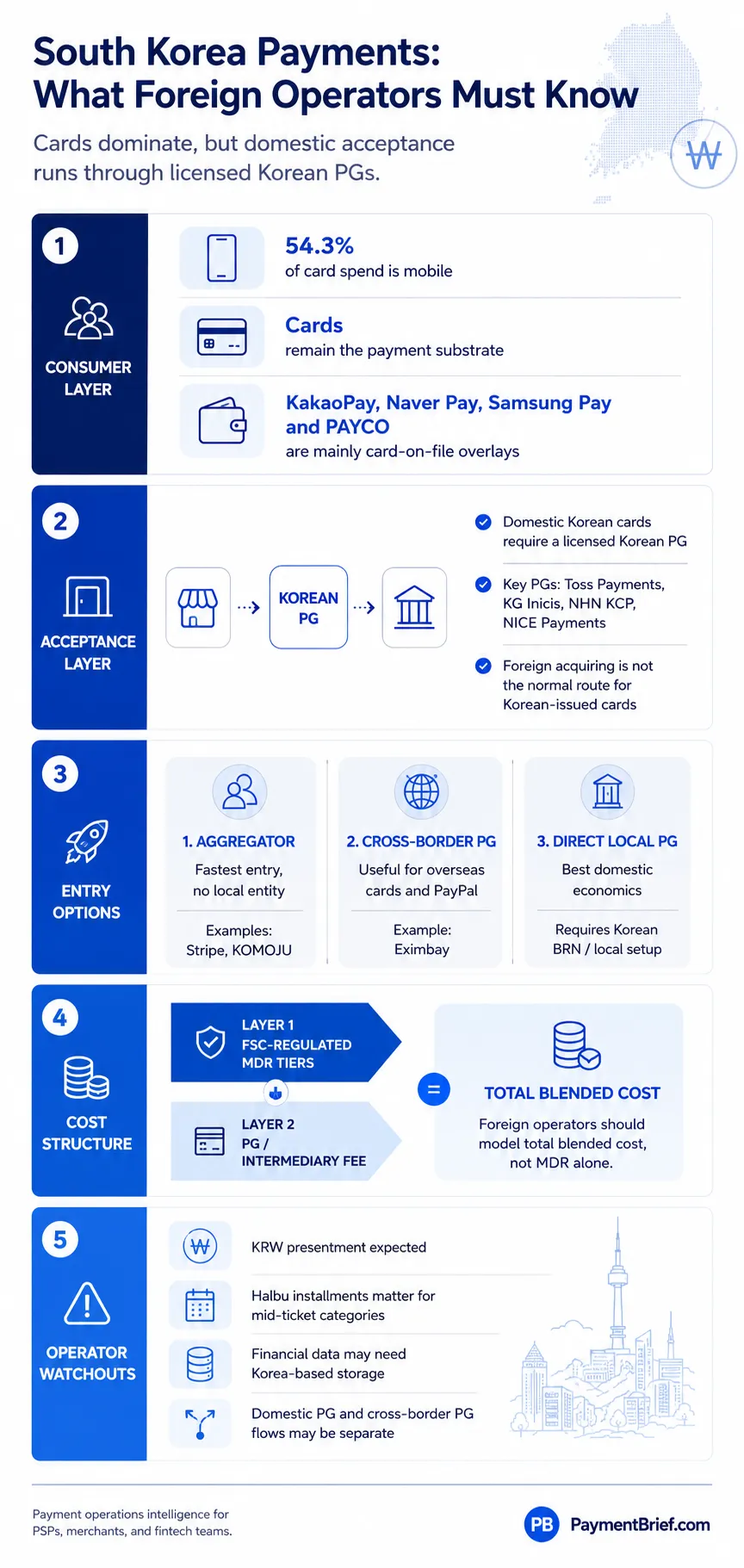
Korean-issued cards require a licensed local PG (KG Inicis, Toss, NHN KCP) — foreign acquiring isn't possible. Wallets are card-on-file overlays via the PG. Card costs have two layers: regulated MDR tiers plus PG fees. Financial data must stay on Korean servers.
South Korea has near-universal card penetration and among the world's highest card-usage intensity per capita. In 2025, mobile overtook physical as the larger share of card spend (Bank of Korea). But Korean-issued cards cannot be acquired by a foreign acquirer directly — foreign operators must route through a licensed Korean PG (Toss Payments, KG Inicis, NHN KCP, NICE). Entry without a local entity is possible via aggregators like Stripe; a direct PG contract requires a Korean Business Registration Number. KakaoPay and Naver Pay are card-on-file overlays bundled through the PG, not separate acquiring relationships. Card MDR is FSC-regulated with a two-layer cost structure: regulated preferential tiers plus a PG/intermediary fee averaging ~1.98%. Financial data must remain on Korea-located servers under EFSR rules.
South Korea’s payment market is built on a paradox: the most card-saturated consumer market on earth is also one of the hardest for a foreign operator to enter with a direct card-acceptance setup. Korean consumers carry multiple credit cards, use them constantly, and have structured their entire retail economy around card rewards and installment plans. Yet the infrastructure that enables this is deliberately domestic — Korean-issued cards route through licensed Korean PGs, not through foreign acquirers.
For a foreign operator, this is the first thing to understand. It shapes every other decision: which intermediary you work with, whether you need a local entity, how much you pay in fees, and how you handle data residency. This guide covers how the system actually works.
The Most Card-Saturated Market on Earth
Korea’s relationship with cards is structural, not accidental. A government-driven formalization push in the late 1990s — combined with deep tax incentive programs tied to card spending — produced a consumer population that genuinely prefers cards for everything, including small purchases that most markets handle with cash or QR.
The 2025 Bank of Korea data crystallizes the scale: daily-average card spend reached approximately KRW 3.1 trillion, of which approximately KRW 1.7 trillion flowed through mobile — up 7.3% year-on-year. Mobile’s share of total card spend rose from 52.4% in 2024 to 54.3% in 2025, meaning mobile has overtaken physical cards as the larger half of Korean card volume (Bank of Korea, 2025). Smartphone penetration sits at approximately 95% (Korea Communications Commission, 2024).
Total card transaction value reached approximately KRW 1,255 trillion (~US$934 billion) in 2024, with credit and charge cards accounting for roughly 80% of value and debit approximately 20%.
Takeaway for operators: cards are the substrate. The wallets, installment plans, and simple-pay apps that layer on top of them are largely card-on-file overlays — not replacements.
The Local-PG Requirement
This is the structural constraint that defines Korean payment access for foreign operators. Korean-issued cards cannot be acquired by a foreign acquirer directly. Domestic-card acceptance requires routing through a licensed Korean payment gateway or acquirer.
Two acceptance paths exist for most foreign merchants:
Path 1 — Domestic Korean cards: route through a licensed Korean PG. The major players are Toss Payments, KG Inicis, NHN KCP, and NICE Payments. KG Inicis processes only Korea-issued cards; overseas-issued cards cannot run through it. Toss Payments, KG Inicis, NHN KCP, and NICE together hold an estimated majority of the domestic PG market (industry estimates; precise shares are not officially published).
Path 2 — Foreign-issued Visa/Mastercard and PayPal: a cross-border PG. Eximbay is Korea’s leading cross-border PG; 2C2P and PayLetter serve specific verticals including content and gaming. This is often a separate integration from the domestic-card route.
Business Registration Number (BRN): contracting a Korean PG directly for a merchant account generally requires a BRN — which means a local legal entity (Korean company, FDI company, or branch). E-commerce businesses also typically need 통신판매업 (mail-order business) registration. The way around this for operators without a local entity is an aggregator that holds the local PG relationship on your behalf — Stripe, KOMOJU, and Eximbay all offer this model.
For a broader view of how South Korea’s market compares with APAC peers, the payment structure context is on the market page.
Simple-Pay Wallets: Card-on-File, Not Displacement
Korea’s major consumer-facing wallets — collectively called 간편결제 (simple pay) — are KakaoPay, Naver Pay, Toss (Viva Republica), Samsung Pay/Wallet, Payco, SSGPay, and Zero Pay.
The most important operator-facing point: most simple-pay wallets are card-on-file overlays. They tokenize underlying domestic cards and still settle through the card/PG rails. “Accepting KakaoPay and Naver Pay” typically comes bundled through your local PG — not as a separate acquiring relationship with Kakao or Naver directly.
For qualitative market positioning: Samsung Pay leads in-store (NFC/tap-to-pay); Naver Pay leads online via its native integration with Naver Smart Store and Naver Shopping; KakaoPay operates as a super-app within KakaoTalk (46M+ monthly active users) covering payments, insurance, brokerage, and credit scoring. Toss bundles payments with a digital bank and brokerage platform, with particularly strong engagement among younger Korean consumers. These positions are from industry reporting — Bank of Korea does not publish wallet-level market share.
The digital wallet layer in Korea is thus best understood as a UX and loyalty layer built on top of the card infrastructure, not a parallel acceptance network. The practical integration consequence: contract the right PG, and wallet acceptance comes with it.
KFTC, Open Banking, and the Won Rails
The Korea Financial Telecommunications & Clearings Institute (KFTC) operates Korea’s interbank retail network, including the Open Banking hub, the interbank transfer system, and multiple clearing systems across the Korean financial sector.
Open Banking launched in December 2019 — making Korea one of the earlier movers on centralized open banking infrastructure in Asia. All major banks plus dozens of licensed fintechs connect via a KFTC-managed API hub. This is the backbone for A2A transfers, simple-pay wallet top-ups, and direct debit flows. The Open Banking API lets licensed operators access account information and initiate transfers across all participating banks via a single integration point. For operators, this matters most for virtual account-based checkout flows and B2B settlement.
BOK-Wire+, the Bank of Korea’s RTGS system, handled a daily-average value of approximately KRW 617 trillion in 2024 (+11.2% YoY) — the high-value settlement layer that sits above the retail rails.
Virtual accounts remain significant for B2C e-commerce, particularly for higher-value transactions where consumers prefer bank-confirmed payment over a wallet charge. A unique per-order virtual account number is generated; customers pay via internet banking or ATM within a set window. Reconciliation is automatic.
For regional context on how Korea’s real-time infrastructure compares with Singapore, Thailand, and Indonesia, see the Real-Time Payment Rails Comparison Matrix.
Card Fees: A Two-Layer Cost Structure
Korea’s card merchant fees are government-influenced via the FSC — a system with no close parallel in other major APAC markets. Understanding the cost structure requires distinguishing two separate layers.
Layer 1 — FSC-regulated MDR tiers. Under the Specialized Credit Finance Business Act, the FSC conducts a cost-based fee re-appraisal approximately every three years and sets preferential rate caps by merchant annual sales bracket. The most recent reform (announced 24 December 2024, effective 14 August 2025) reduced:
- Preferential credit-card MDR: from 0.5–1.5% to 0.4–1.45% (by annual sales bracket)
- Preferential debit/check card MDR: to 0.15–1.15% (by annual sales bracket)
Approximately 95.7% of Korea’s roughly 3.21 million merchants qualify for these preferential rates. These are the regulated merchant discount rates — the cap that card companies charge small and medium merchants.
Layer 2 — PG/e-finance intermediary fee. Separately, the FSS disclosed in September 2025 that the average card payment fee across 18 e-finance (PG/intermediary) firms was ~1.98% (prepaid: ~1.74%). This is the fee charged by the PG/intermediary layer — a distinct cost on top of the FSC-regulated card MDR, not a replacement for it.
For most foreign operators: the preferential MDR rates apply to small domestic merchants, not to large foreign operators. The FSS-disclosed ~1.98% intermediary average is the more operationally relevant reference point for what most foreign merchants will actually pay. Total blended cost = regulated MDR + PG/intermediary layer.
Halbu (할부) — installment payments. Korea’s deeply embedded credit card installment system allows purchases above approximately KRW 50,000 to be split into 2, 3, 6, 12, or 24 monthly installments. Most consumer purchases above mid-ticket in categories like electronics, fashion, and travel are offered with interest-free halbu; the merchant subsidises the financing cost. Local PGs surface halbu automatically. Foreign operators who do not expose halbu at checkout in these categories will lose conversion.
Regulatory Framework: FSC, FSS, EFTA
The Financial Services Commission (FSC) sets financial-sector policy; the Financial Supervisory Service (FSS) handles supervision and compliance. Both govern the Electronic Financial Business licensing framework.
Governing statute: the Electronic Financial Transactions Act (EFTA) is the core law for electronic financial transactions. Operating as a domestic e-finance business requires an Electronic Financial Business licence — with categories including Payment Gateway Operator, Electronic Prepayment Means (stored value/e-money), Electronic Funds Transfer, and Electronic Money Issuer. A domestic entity is required for direct licensing in practice.
Authentication: the mandatory ActiveX/accredited-certificate regime was abolished on 10 December 2020 via the Digital Signature Act amendment, switching Korea to a technology-neutral authentication framework. In practice, App Card, ISP (Internaional Secure Payment), simple-pay PIN/biometrics, and 3DS coexist. The legacy ActiveX requirement is gone — but Korea-specific app-based authentication (App Card) remains the norm for card-not-present flows, which is a real UX and integration consideration for foreign checkout operators.
Data Residency: EFSR and the EU Adequacy Exclusion
This is an area where precision matters for operators designing system architecture.
Korean financial-sector rules (EFSR) require domestic storage of financial data. Public-cloud systems handling financial or credit information must sit on servers located in Korea. Network-segregation rules require separation of internal and external networks — the FSS has treated offshore access to financial systems (including “global support” access) as a potential violation. Phased relaxation has been underway since August 2024, but this is a gradual process, not an open door.
EU adequacy decision (September 2025): PIPC (Korea’s data-protection authority) obtained an EU adequacy decision that eases KR→EU personal-data transfers. However, this decision expressly excludes personal credit information and FSC-supervised credit data. It does not automatically permit offshore processing of Korean financial data and does not override EFSR requirements. Foreign operators should not assume that the EU adequacy decision covers their financial-data architecture — it does not.
Practical implication: design for in-country financial-data storage from the outset. Confirm the scope of any cloud or data-processing arrangement with your Korean PG and legal counsel, particularly if you operate global infrastructure that would otherwise process Korean financial data outside Korea.
Cross-Border QR Interoperability
A note on QR in Korea: the wallet landscape is well-served by in-app simple pay, and there is no verified domestic unified national QR standard equivalent to Indonesia’s QRIS.
What is verified: KFTC is leading cross-border QR interoperability work, with a Korea-Indonesia link reported live approximately April 2025 and links to India and Vietnam planned. This is an outbound connectivity story — enabling Korean wallets to be used by Koreans travelling overseas, and vice versa — not a domestic QR standardization initiative. Frame it accordingly.
FX, KRW, and Settlement Friction
KRW is the domestic settlement currency, and the won is not fully internationalized. FX is liberalized but not free-flowing.
Key operational realities for foreign operators:
- Settlement is in KRW domestically; cross-border merchants settle out via FX banks
- Repatriation of proceeds above approximately US$500,000 must generally occur within ~18 months; larger flows trigger declaration and documentation requirements under MOSF/BOK reporting rules
- Payout timing via aggregators runs approximately T+4 (US accounts) / T+7 (outside US) per Stripe Korea documentation
- KRW presentment — Korean consumers expect KRW at checkout; FX conversion at the acquirer side, not consumer side
Budget for an FX-bank relationship and longer payout timelines relative to, say, Singapore or Hong Kong. For operators expecting significant Korea revenue, capital controls and repatriation friction are worth building into treasury planning.
What This Means for Operators
Entry paths, ranked by speed and structural commitment
Path 1 — Aggregator, no local entity (fastest): Stripe supports Korea without a local entity via a local processor, accepting Korean domestic cards plus KakaoPay, Naver Pay, Samsung Pay, and PAYCO with KRW presentment (Stripe Korea docs, 2026). KOMOJU offers a similar aggregator model for Korea with Japanese-market integration. This path works well for most foreign merchants entering the market.
Path 2 — Cross-border PG: Eximbay is Korea’s leading cross-border PG and handles international cards plus select domestic methods. Useful for predominantly international audiences transacting in Korean storefronts, or for gaming/content verticals (PayLetter).
Path 3 — Direct local PG contract (full domestic economics): Toss Payments, KG Inicis, NHN KCP, or NICE Payments. Full domestic-card economics, halbu integration, and complete wallet bundling. Requires a BRN (local entity). Necessary if you are the merchant of record in Korea or need the full local fee structure.
Non-obvious requirements
- Two-PG reality: a domestic PG (Korean-issued cards) and a cross-border PG (overseas-issued Visa/Mastercard, PayPal) are structurally separate. A single integration through Stripe or KOMOJU resolves this; a direct PG contract means managing both legs
- Wallets are bundled, not standalone: KakaoPay, Naver Pay, and Samsung Pay come via the PG — not separate acquiring relationships
- MDR has two layers: regulated preferential MDR (small domestic merchants) and PG/intermediary fee (~1.98% FSS avg). Large foreign operators pay the latter, not the former
- Data residency is real: financial data stays on Korean servers. Design for this; the EU adequacy decision does not cover FSC-supervised financial data
- Halbu is expected: for mid-ticket and above in consumer electronics, fashion, and travel, exposing installment options at checkout is a conversion requirement, not a feature
Regulatory watch (2025–2026)
- BOK’s Project Hangang (Phase 2 resumed March 2026) is Korea’s CBDC programme — wholesale phase currently; no direct merchant acceptance path exists for foreign operators
- Digital Asset Basic Act covering crypto issuance and trading is expected in 2025–2026; KRW stablecoin activity from KakaoBank and Naver is the most operationally relevant development to monitor
- MyData expansion (personal data portability under the Credit Information Use and Protection Act) continues to extend consumer data rights — relevant for operators building data-intensive financial products in Korea
- The KFTC cross-border QR rollout (India, Vietnam planned after Indonesia live) may gradually expand the utility of Korean wallet acceptance for cross-border travel and e-commerce flows
Korea rewards operators who understand the local-PG structure and commit to it. The regulatory and fee environment is transparent and stable — the FSC publishes MDR reform decisions explicitly, and the KFTC’s open-banking infrastructure is mature. The complexity is structural rather than opaque.
Sources
Bank of Korea Payment and Settlement Systems Report — 2025 card spend data: daily-average card spend KRW 3.1tn; mobile share 54.3% (up from 52.4% in 2024), overtaking physical card spend
Checked:
FSC press release 24 Dec 2024: preferential credit-card MDR for small/midsize merchants reduced from 0.5–1.5% to 0.4–1.45%; debit/check card to 0.15–1.15%, by annual sales bracket under the Specialized Credit Finance Business Act; effective 14 August 2025; approximately 95.7% of 3.21M merchants qualify
Checked:
FSS disclosure Sept 2025: average card payment fee across 18 e-finance firms 1.98% (prepaid 1.74%) — this is the PG/intermediary fee, a separate cost layer from the FSC-regulated merchant discount rate
The 1.98% figure is the PG/e-finance intermediary fee across 18 firms — NOT the FSC-regulated MDR tiers
Checked:
KFTC Open Banking launched December 2019; centralized API hub managed by KFTC; all major banks plus dozens of fintechs participate; backbone of A2A transfers and simple-pay wallets
Checked:
The Electronic Financial Transactions Act (EFTA) is the core statute governing electronic financial transactions in Korea; FSC sets policy, FSS supervises compliance
Checked:
Stripe supports Korea without a local entity via a local processor; accepts Korean domestic cards plus KakaoPay, Naver Pay, Samsung Pay, PAYCO; KRW presentment; payout T+4 (US) / T+7 (outside US)
Checked:
Mandatory accredited certificate (공인인증서 / ActiveX) abolished 10 December 2020 via Digital Signature Act amendment; Korea now operates a technology-neutral authentication regime
Checked:
KFTC-led cross-border QR interoperability: Korea-Indonesia link live approximately April 2025; India and Vietnam planned — framed as cross-border QR interoperability, not a domestic QR standardization
Cross-border QR interoperability only — no primary source supports a 'unified domestic national QR standard (Jan 2025)' claim
Checked:
Source types explained in our Methodology.
 By Shaun Toh · Director, Digital Payments · Razer
 Subscribers get the PSP Selection RFP Kit — 60+ structured questions, evaluation scorecard, and negotiation playbook — delivered to your inbox instantly.