TechCrunch — Telebirr, Ethiopia's mobile money service, hits 40M users two years after launchIndustry data
Telebirr launched May 2021; hit 40M+ users by 2023 — described as fastest mobile money ramp in Africa
40M users, 2 years
Checked:
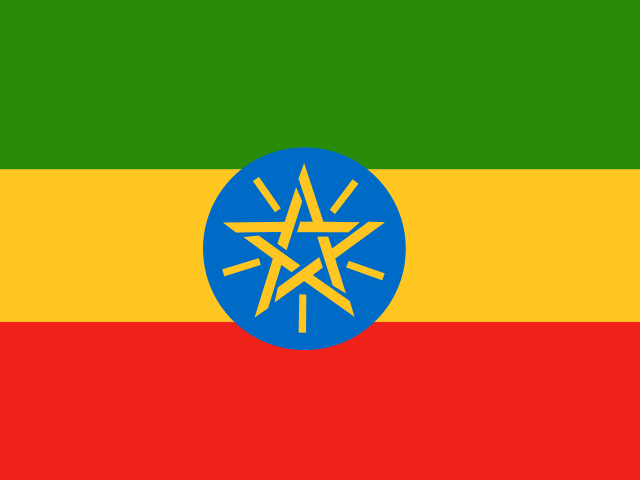
Africa's second-largest population with the fastest mobile money ramp in history — Telebirr hit 40M users in two years, but ETB is not freely convertible.
Top payment methods
Shares are approximate and may overlap (e.g. wallets sitting on cards) or use different denominators (e-commerce vs POS). See FAQ + sources below for context.
Infrastructure
The active payment categories in Ethiopia — their role, adoption, and market position.
Instant account-to-account fund transfers settled in seconds via a national rail.
Credit and debit card payments processed over Visa, Mastercard, and local networks.
Mobile-first stored-value wallets enabling QR, NFC, and in-app checkout.
Direct debit and credit transfers between bank accounts for high-value settlements.
Instalment-based lending at checkout; growing fast across Southeast Asia.
Physical currency; still significant in markets with lower banking penetration.
Analytics
Estimated share of consumer payment volume by method.
Estimates based on reported transaction volumes. Data as of May 15, 2026. Percentages rounded to nearest whole number.
Rail Profile
Ethiopia's national real-time payments rail — enabling instant, 24/7 account-to-account transfers.
How payments flow
Telebirr (telco-led) + EthSwitch (interbank)
Real-time · ~1 sec
No intermediary PSP float. Settled instantly, 24/7. Near-zero MDR for merchants.
Card Payment
Auth ~2–3 sec · T+1 settlement
3DS2 authentication on CNP. MDR 1.0%–2.5% (estimated) (debit) or 2.0%–3.5% (estimated; limited card infrastructure) (credit). Issuer holds chargeback liability.
E-Wallet (Mobile Wallet)
Instant · local rail
Mobile wallet backed by local instant payment rail. MDR 0–1.5%.
Deep Dive
Ethiopia is Africa's second-largest population (~120M) and one of the largest underserved payment markets globally. Banking penetration sits at approximately 35–40%, leaving the majority of adults outside the formal financial system. Telebirr — launched by state-owned Ethio Telecom in May 2021 — reached 40M+ users by 2023, the fastest mobile money user acquisition ramp in African history. Ethiopia's financial sector was closed to private and foreign operators until a landmark 2019 liberalisation; Safaricom and MTN were awarded the first two private telco licences in 2021, with Safaricom Ethiopia beginning to roll out M-Pesa services in 2023–2024. The foundational operator constraint: the Ethiopian Birr (ETB) is not freely convertible, and profit repatriation requires National Bank of Ethiopia (NBE) approval — the primary operational risk for any foreign operator with material ETB revenue exposure.
Telebirr is operated by Ethio Telecom, the state-owned telco that held a monopoly over Ethiopian telecommunications until 2021. Launched May 2021, Telebirr was built on Ethio Telecom's 50M+ subscriber base and positioned from inception as a national financial inclusion vehicle with explicit government backing.
Why the ramp was so fast: USSD-first architecture (no smartphone required) extended reach to basic handsets across rural Ethiopia. G2P (government-to-person) disbursements — government subsidies, salary flows for public sector workers — were channelled through Telebirr early, driving adoption among recipients who had no prior mobile money relationship. There was no competing telco wallet to fragment demand. The combination of captive distribution, government mandate, and USSD accessibility produced a 40M user base in roughly two years — a pace that M-Pesa Kenya took approximately five years to achieve.
For operators: Telebirr merchant acceptance fees vary by volume and merchant category but are typically 0%–1.5% MDR — below card MDR for comparable transactions. Direct Telebirr merchant integration is available via Ethio Telecom's developer programme; local banking partners (CBE, Awash, Dashen) also offer Telebirr as part of bundled payment acceptance.
CBE Birr is the digital wallet of the Commercial Bank of Ethiopia (CBE), Ethiopia's largest bank by a wide margin — CBE holds the majority of the country's bank deposits and has the broadest branch network. CBE Birr provides wallet-based mobile payments anchored to a CBE account, and CBE's scale means it reaches a significant share of Ethiopia's banked population.
EthSwitch is the national interbank payment switch, operating as the settlement backbone for transfers between Ethiopian banks. For operators handling B2B payables, payroll into bank accounts, or formal institutional flows, EthSwitch is the relevant real-time rail. Consumer-facing volume is dominated by Telebirr; institutional and formal-sector flows use EthSwitch.
Safaricom (in consortium) received a private telco licence in May 2021 — the first issued in Ethiopia outside state ownership — alongside MTN. Safaricom Ethiopia began rolling out M-Pesa services in 2023–2024. The rollout faces a structural challenge: Telebirr's 40M+ user headstart means Safaricom Ethiopia must build both network coverage and mobile money adoption simultaneously, unlike Safaricom Kenya's position of launching M-Pesa on an established network.
The longer-term competitive dynamic will be Telebirr (state-backed, incumbent distribution) vs M-Pesa (Safaricom's product experience, cross-border interoperability corridors). For operators planning East Africa infrastructure, see the M-Pesa interoperability briefing for how Ethiopia fits into the regional M-Pesa corridor picture.
ETB is not freely convertible. The NBE administers Ethiopia's exchange rate and controls FX allocation — operators cannot freely convert ETB revenue into USD or other currencies on the open market. The practical workflow for foreign operators: revenue accumulates in ETB; conversion requires an NBE FX application through a licensed Ethiopian banking partner; reported wait times range from weeks to months depending on NBE FX reserve availability and application priority.
Structural risk factors for Ethiopia revenue models: ETB/USD devaluation during the holding period between collection and repatriation; NBE policy changes affecting FX priority (the NBE has at various times prioritised manufacturing imports over financial services repatriation); banking partner dependence for FX quota access. For operators building Ethiopia into cross-border B2B AR models, ETB exposure should be stress-tested explicitly against devaluation and delay scenarios.
The most common mitigation: structure Ethiopia operations through a local banking partner with an established NBE FX quota, and price ETB-denominated contracts with a devaluation buffer.
The National Bank of Ethiopia (NBE) regulates payment activity under the Payment Instrument Issuers Directive and subsequent payment system regulations. Post-2019 liberalisation allows foreign investment in financial institutions with NBE approval; ownership thresholds and conditions vary by institution type.
Licence categories: mobile money operator; payment system operator; payment instrument issuer. Practical entry path for most foreign operators: local banking partnership (CBE, Awash Bank, or Dashen Bank as the regulated entity) rather than direct NBE licensing. Direct licensing timelines are estimated at 12–18 months for complete applications. New entrants in 2023–2025 have predominantly used the banking-partner route for speed.
International PSP presence in Ethiopia is limited. Flutterwave has stated Ethiopia coverage, but operator-facing depth is thin. Stripe does not operate in Ethiopia. The practical PSP layer is domestic-bank-led: Telebirr direct, CBE Birr direct, and Dashen Bank's digital wallet. For international card acceptance (inbound tourism, expatriate flows in Addis Ababa), processing is typically routed through a Kenyan or regional acquiring partner.
For East African regional payment strategy, Tanzania and Rwanda offer comparable mobile money penetration with materially lower regulatory and FX complexity than Ethiopia.
State-owned Ethio Telecom had an existing subscriber base of 50M+ before Telebirr launched, providing built-in distribution that no competing mobile money operator in Africa has matched. The Ethiopian government treated Telebirr as a national financial inclusion instrument — G2P disbursements (government-to-person transfers) were channelled through Telebirr from early on, driving a degree of forced adoption among subsidy recipients. Critically, Telebirr launched as USSD-first (no smartphone required), which meant even low-end handsets could participate. Ethio Telecom's monopoly telco position, which persisted until Safaricom and MTN received licences in 2021, meant there was no competitor to fragment the user base. The combined effect — large captive subscriber base, USSD accessibility, government mandate, G2P integration — produced a user ramp no private telco-led launch has replicated.
The Ethiopian Birr (ETB) is not freely convertible on the open market — the National Bank of Ethiopia (NBE) controls FX allocation through an administered exchange rate system. Foreign operators collecting ETB revenue must apply to the NBE for FX conversion and repatriation approval; reported delays range from weeks to months depending on available FX reserves and NBE prioritisation. Operators with significant Ethiopia volume typically structure their entry through a local banking partner (Commercial Bank of Ethiopia, Awash Bank, Dashen Bank) that holds an NBE FX quota, using the partner bank's allocation to smooth repatriation timing. The practical implication: Ethiopia revenue projections must account for ETB holding periods and potential devaluation risk during the interval between collection and repatriation. This is the primary operational risk for foreign operators entering the market, and should be stress-tested against historical ETB/USD rate movements.
Safaricom won one of two new private telco licences in 2021 — alongside MTN — breaking Ethio Telecom's monopoly. M-Pesa Ethiopia services began rolling out in 2023–2024. Telebirr has a substantial structural headstart: 40M+ users built on Ethio Telecom's existing network vs Safaricom Ethiopia's position building subscriber and merchant networks from scratch. The longer-term dynamic will be a Telebirr vs M-Pesa contest — unusual among African markets because no other market has both a Safaricom M-Pesa and a dominant state-telco wallet competing at scale simultaneously. For operators, the practical implication is that a single-wallet integration strategy (Telebirr only) carries less risk in 2024–2025, but M-Pesa's merchant and developer ecosystem may make dual integration worthwhile as Safaricom Ethiopia's network matures.
The NBE issues payment institution licences under the Payment Instrument Issuers Directive and subsequent payment system regulations. Licensing categories include mobile money operator, payment system operator, and payment instrument issuer. Before 2019, foreign ownership in Ethiopian financial services was effectively prohibited. Post-2019 liberalisation allows foreign investment in financial institutions subject to NBE approval and ownership caps that vary by institution type. Practical licensing timelines for full direct NBE authorisation are estimated at 12–18 months. Most foreign operators entering Ethiopia use local banking partnerships rather than direct NBE licensing — CBE, Awash Bank, and Dashen Bank are the common local partner routes, with the bank holding the regulated licence and the foreign operator providing technology or product.
Ethiopia has approximately 60% of adults unbanked — a higher proportion than Nigeria (approximately 45% unbanked on a larger ~220M population), and a similar proportion to Bangladesh or Pakistan. Unlike Nigeria, which developed a competitive private banking sector through the 2000s, Ethiopia's financial system was state-dominated until the 2019 liberalisation, suppressing private bank formation and leaving a much thinner banking infrastructure base outside Addis Ababa. Post-2019, 10+ new private bank licences have been issued, but the sector remains in early catch-up. The unbanked opportunity is real in absolute numbers, but the infrastructure gaps — power, connectivity, agent density outside Addis — and capital controls mean conversion of that latent demand into processed volume is slower than comparable opportunity profiles in Nigeria or even Tanzania would suggest.
Telebirr launched May 2021; hit 40M+ users by 2023 — described as fastest mobile money ramp in Africa
40M users, 2 years
Checked:
Safaricom consortium wins Ethiopia's second telecom licence in 2021, opening market to private telco competition
Checked:
Ethiopia 2019 financial sector liberalisation; FX controls and banking sector structure
Checked:
Ethiopia banking penetration approximately 35–40%; large unbanked population
Checked:
NBE payment system regulation; Payment Instrument Issuers Directive; licensing framework
Checked:
Mobile money landscape and Ethiopia coverage including Telebirr
Checked:
EthSwitch interbank payment switch operations
Checked:
Ethiopia GDP per capita, economic outlook, financial sector development
Checked:
Source types explained in our Methodology.
Compliance
Payments in Ethiopia are governed by National Bank of Ethiopia (NBE). PSPs require a NBE payment institution licence; mobile money under NBE Payment Instrument Issuers Directive licence to operate.
NBE payment institution licence; mobile money under NBE Payment Instrument Issuers Directive issued by National Bank of Ethiopia (NBE).
FATF-compliant AML/CFT obligations apply. KYC, transaction monitoring, and suspicious activity reporting required for all licensed PSPs.
Payment transaction data subject to national data protection laws. Cross-border data transfers require appropriate safeguards.
Economics
Typical MDR ranges for merchants accepting payments in Ethiopia. Rates vary by acquirer, card type, and merchant category.
| Payment Type | Typical MDR Range |
|---|---|
| Credit Card | 2.0%–3.5% (estimated; limited card infrastructure) |
| Debit Card | 1.0%–2.5% (estimated) |
| E-Wallet | 0%–1.5% (Telebirr merchant fees vary) |
| Real-Time Payment | 0.00% – 0.10% |
Rates are indicative and subject to change. Verify current rates with your acquirer or PSP.
Ecosystem
Payment service providers with confirmed Ethiopia market support. Not a ranking.
Telebirr (direct)
Payment services provider operating in this market.
CBE Birr (direct)
Payment services provider operating in this market.
Dashen Bank digital wallet
Payment services provider operating in this market.
Safaricom Ethiopia / M-Pesa
Payment services provider operating in this market.
Intelligence
Analysis and deep-dives related to Ethiopia payments.
Cross-border B2B receivables break at the infrastructure level: SWIFT delays, memo truncation, FX timing, reconciliation gaps. What modern AR needs.
M-Pesa has grown from a closed-loop Kenyan wallet to a multi-country network with interoperability mandates and API access. What operators need to know.
SWIFT gpi improved speed and transparency, but bilateral real-time rail links and project Nexus are challenging its dominance on key corridors.
Last updated: May 15, 2026