MoR vs PSP: When the Premium Beats Doing It Yourself
MoR vs PSP: who owns tax remittance and chargeback liability, and when direct PSP beats paying the MoR premium. Decision framework for digital and SaaS sellers.
MoR providers take on tax, fraud, chargeback handling and global compliance — and charge a premium. The right question is not the premium but how much compliance infrastructure you would build to replace what they handle.
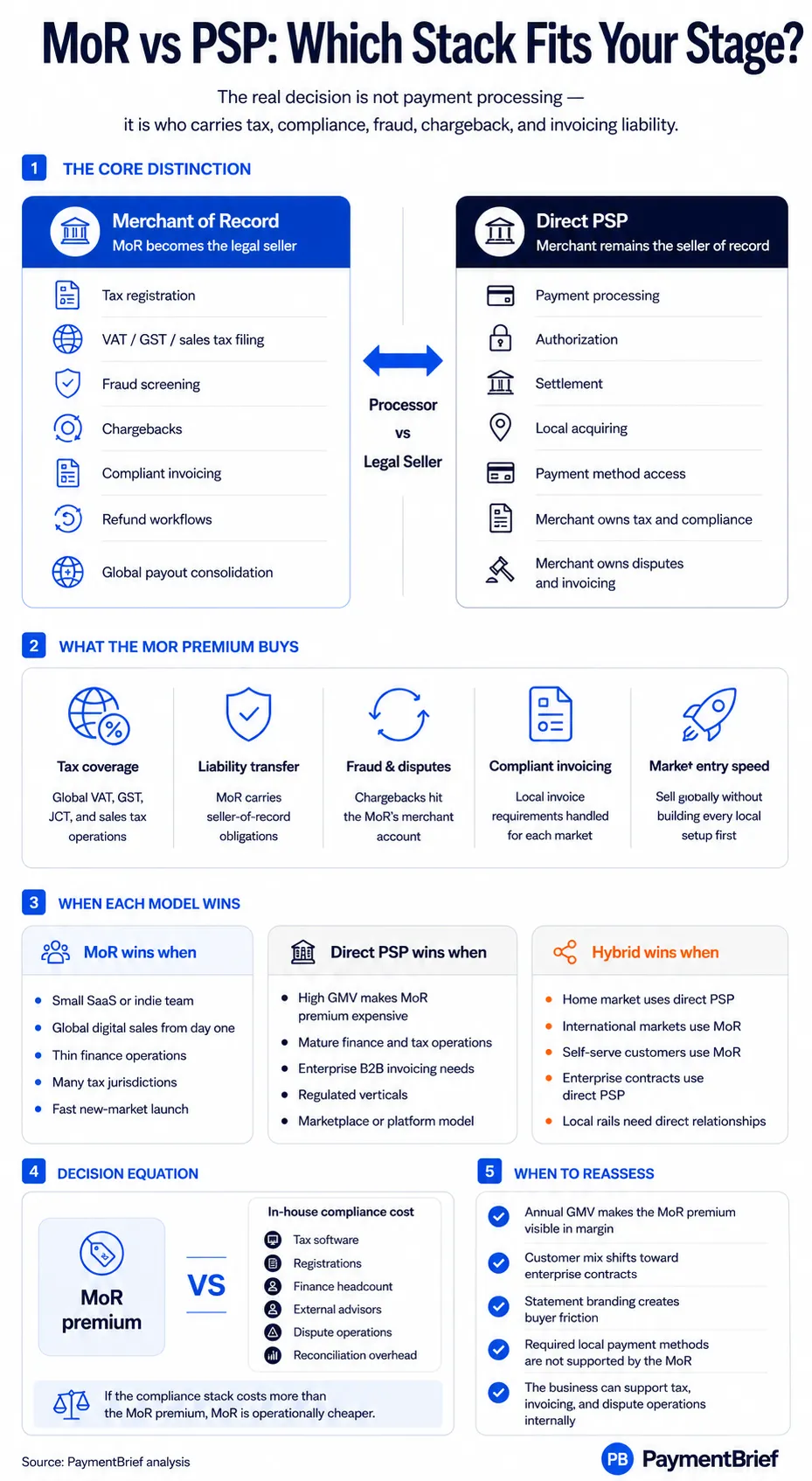
A Merchant of Record (MoR) is the legal seller of record for a transaction — they own tax collection and remittance, chargeback liability, refund handling, and the card-network merchant relationship. A PSP (Payment Service Provider) only processes the payment; the merchant remains the seller of record and retains all compliance and tax obligations. MoR providers charge a higher take rate than direct PSP processing because they assume that compliance and tax burden. MoR wins when the seller is small, sells digital products globally from day one, or operates in a vertical where tax compliance across many jurisdictions would dominate the early operating cost. Direct PSP wins when volumes are high enough that the MoR premium exceeds the cost of building or buying tax and compliance infrastructure separately.
Every operator selling digital products globally eventually faces the same question — one that sits at the heart of PSP and infrastructure decisions. The credit-card-acceptance side of the stack is solved — Stripe, Adyen, Braintree, or a regional acquirer will process the payment. The harder question is everything around the payment: who registers for VAT in 27 EU member states, who files US state sales tax returns under post-Wayfair economic nexus rules, who handles a customer's chargeback two months after the sale, who is legally the seller when the card-network rulebook asks.
This is the question that determines whether you use a Merchant of Record or a direct PSP. It is not a technical question — both systems can process the same transaction. It is a question about which entity carries which liability.
What a Merchant of Record Actually Is
A Merchant of Record (MoR) is the legal entity that sells the product to the end customer. The MoR signs the customer-facing terms of sale. The MoR's name appears on the customer's bank or card statement. The MoR collects, remits, and files taxes in every jurisdiction where the sale creates an obligation. The MoR's card scheme merchant identifier carries the transaction, and the MoR receives any chargeback the customer initiates.
The underlying seller — typically a SaaS company, digital product creator, or developer tools vendor — supplies the product and brand, but is structurally a wholesaler to the MoR. The MoR pays the seller a net amount after its fees, taxes collected, and any other deductions specified in the agreement.
A PSP, by contrast, does not become the seller. The PSP processes the payment as an agent. The merchant remains the seller of record, retains the obligation to register for and remit taxes, owns the customer relationship for chargeback and refund purposes, and operates under its own card-network merchant identifier (or an aggregated payment facilitator arrangement that is structurally distinct from MoR).
The single most important distinction is liability. The MoR carries the seller's legal liability for everything that flows from a sale. The PSP does not.
What the MoR Premium Actually Buys
MoR providers charge a higher take rate than direct PSP processing. The premium varies by provider and product line, and changes often enough that a published comparison is operationally hard to maintain — vendors revise pricing more than once a year, and the structure varies (some have flat take rates, some have transaction fee plus percentage, some have volume tiers, some have separate currency conversion charges).
The more useful question is structural: what does the premium buy that you would otherwise have to build, buy, or absorb? In the typical MoR-versus-PSP comparison, the premium covers some or all of the following:
Global tax registration, collection, and remittance. EU VAT on digital services shifted to the consumer's-country rate in January 2015. The EU One-Stop Shop (OSS) consolidates filings into one return per quarter but does not eliminate the underlying liability — you still owe VAT at the rate of the buyer's country. The UK is a separate registration. Norway and Switzerland are separate registrations. Australia GST on imported digital services, Japan JCT, India GST on cross-border digital services, and Singapore GST on imported services all create their own obligations. US state sales tax, post-Wayfair, creates economic nexus in each state where you cross a state-specific threshold (typically dollar volume or transaction count). The MoR handles all of this. The PSP does not — the PSP at most offers tax-automation tooling that helps you handle it.
Fraud and chargeback liability. Card-not-present digital goods are a high-risk fraud category. Chargebacks are filed against the MoR's MID, not yours. The MoR runs fraud-screening on the transaction. The card-network thresholds for excessive chargeback programmes (VAMP/VDMP at Visa, Excessive Chargeback Merchant at Mastercard) apply to the MoR's aggregate book; an isolated incident at your store does not threaten your processing standing because you do not have processing standing under a MoR — they do.
Sales tax and invoicing operations. EU invoicing rules require specific information on invoices, including the buyer's VAT ID for B2B reverse-charge transactions. UK invoicing rules differ. The MoR generates compliant invoices in each jurisdiction. The PSP does not.
Currency conversion and payout consolidation. MoRs typically pay sellers in a small number of consolidated currencies regardless of the buyer's country, absorbing the currency-conversion complexity. Direct PSPs offer this as a feature, but at varying quality and cost.
Refund and dispute handling. The MoR usually offers a self-service refund process for customers and absorbs the chargeback-versus-refund decision. The seller is involved when policy or evidence is required, but the MoR runs the workflow.
Where MoR Wins Clearly
Three categories of seller benefit most from MoR.
Indie developers, solo founders, and small SaaS companies selling globally from day one. The compliance infrastructure to handle global digital VAT, US state sales tax, and chargeback management is significant fixed cost. For a one-to-three-person company, the MoR premium is rounding error compared to the time and money required to set up registrations across 30-plus jurisdictions. A detailed comparison of MoR providers — Paddle, Polar, Lemon Squeezy, and FastSpring — shows how each targets this segment differently.
Digital product creators and information products. Course sellers, plugin and theme developers, AI-product builders, and digital marketplace operators face the same global VAT problem with usually thinner finance operations than venture-backed SaaS. The MoR removes the entire tax stack from their concern.
Companies launching into new markets quickly. When a fast-moving operator wants to start selling to a new country, MoR offers a near-zero-effort entry: the MoR is already registered there. Setting up tax registration and a local entity, by contrast, can take months. Many companies use MoR specifically as a market-entry tool — sell through the MoR while assessing volume, transition to direct PSP once volume justifies the local infrastructure.
Where Direct PSP Wins Clearly
Three categories of seller usually do not use MoR, or move off it once they have scaled.
High-volume sellers with mature finance operations. At sufficient scale, the MoR premium becomes a meaningful operating-margin drag. A company processing nine-figure annual GMV through an MoR is paying enough that it economically justifies hiring a tax-compliance team, contracting with Stripe Tax, Avalara, TaxJar, or Anrok, and registering directly — though operators moving to a direct PSP should review PSP contract red flags before signing. The threshold is not a single revenue number — it depends on the jurisdictional spread of the business, the tax-automation tooling chosen, and how many full-time roles the in-house team would absorb — but it is real, and it is where most companies that started on MoR eventually transition.
B2B sellers with custom invoicing and contracting requirements. Enterprise B2B customers often require invoices issued directly from the vendor, contractual line items specific to the customer, custom payment terms (net-30, net-60, milestone billing), and frequently negotiate the underlying contract with the seller, not the MoR. MoR makes this awkward. The accounts-payable team at the buyer expects to see the vendor brand as the payee, and the contract holder is the vendor, not the MoR.
Regulated industries and marketplace operators. Financial services, regulated digital assets, healthcare, and similar regulated verticals usually need direct relationships with licensed acquirers and cannot operate through a third-party MoR for regulatory reasons. Marketplaces have their own structural reasons — they typically need payment facilitator or marketplace-specific arrangements (Stripe Connect, Adyen for Platforms) rather than MoR, because the seller-to-buyer relationship is on the platform, not on the MoR.
The Hybrid Pattern
The cleanest operator outcome is often neither MoR-only nor PSP-only but hybrid.
A common split: direct PSP for the home market (where the company already has tax registration and a finance team), MoR for the rest of the world (where the compliance overhead would be disproportionate to the early revenue). As specific international markets cross revenue thresholds, they migrate one at a time off MoR onto direct PSP plus tax automation.
Another split: by customer segment. Self-serve and SMB customers — the high-volume, low-touch segment where chargeback exposure is highest and tax complexity per dollar is highest — go through MoR. Enterprise contracts, which expect direct invoicing relationships and negotiated payment terms, go through direct PSP.
A third split: by payment method. Cards and global wallets go through MoR for the compliance package. Local A2A rails (Pix, UPI, local bank transfers) that the MoR does not yet support go through direct relationships in those markets, or through specialised local providers.
The hybrid stack has integration overhead — two payment systems, two reconciliation flows, two reporting surfaces — but it is often the most operationally honest configuration once a company has grown past pure MoR but has not yet justified a full in-house compliance build.
FREE DOWNLOAD
Free: The PSP Selection RFP Template
60+ RFP questions, a weighted scorecard, and negotiation levers for choosing a PSP. Free PDF — no email required.
The Decision Framework
The right question is not "MoR or PSP" in the abstract — it is which infrastructure cost dominates for the specific business.
Start with the inventory of jurisdictions you sell to today and plan to sell to in the next 12 months. For each, ask: do we need to be registered for VAT, GST, JCT, or state sales tax in this jurisdiction at our current or projected volume? For digital sales to consumers in the EU, UK, Australia, Norway, Switzerland, Japan, India, Singapore, Canada (GST/HST), and many US states, the answer at almost any commercial volume is yes.
Then count the headcount, software cost, and external advisor cost to build that compliance stack in-house. If that cost exceeds the MoR premium for your projected GMV, MoR is cheaper. If it is meaningfully below, direct PSP plus tax automation is cheaper.
Layer in the non-cost factors. Customer trust and statement branding: does the MoR brand on the statement create friction in your buyer's purchasing experience? Customer data ownership: does the MoR's standard arrangement restrict your access to customer email, billing data, or transaction history in ways your marketing or product team needs? Refund and dispute control: do you need direct authority over refund decisions, or are you comfortable with the MoR's policy?
Finally, the cost of optionality. A MoR contract typically includes data-portability obligations on the MoR's side (you can usually export customer and transaction data) but the customer's billing relationship is with the MoR — moving customers off MoR onto direct PSP requires re-authorization, which has a churn cost. The cost of staying on MoR longer than needed is the premium. The cost of leaving MoR too early is the build-out of infrastructure that may not yet have scale to justify itself.
A Note on the Stripe-Owned MoR Players
Stripe acquired Lemon Squeezy in July 2024. The acquisition matters for one specific reason: it positions Stripe to offer both direct PSP processing (Stripe Payments) and a MoR product (Lemon Squeezy) under one corporate roof — and to operate the transition between them, in either direction, as a product rather than a migration. Companies that start on Lemon Squeezy for the global-day-one MoR coverage can in principle transition to direct Stripe processing as they scale without changing payments vendor. Whether Stripe leans into this strategy or keeps the two products structurally separate is something to watch over the next 12-24 months.
Paddle, Polar, FastSpring, and other independent MoR providers continue to operate on the original MoR model: pure MoR, no direct PSP product, positioned as a deliberate alternative to the build-it-yourself stack.
When to Reassess
MoR-versus-PSP is not a one-time decision — understanding when a Merchant of Record stops making sense is as important as the initial selection. Reassess at three triggers.
First, when annual GMV approaches the point where the MoR premium exceeds the cost of an in-house compliance team plus tax-automation tooling. This is usually visible in the finance model before it shows up in the bank account, and the migration is significant enough that planning 6-12 months ahead is the right cadence.
Second, when the customer mix shifts toward segments that fit MoR poorly. A consumer-first SaaS company that signs its first enterprise contracts often finds the MoR-on-statement issue arises quickly. Either route enterprise through direct PSP from the start, or accept that the first dozen enterprise customers will be on MoR while you build the direct relationship.
Third, when the MoR's product gaps become commercially material. If the MoR does not support a critical payment method in a market that has become important to you — local A2A rails, regional wallets, specific buy-now-pay-later products, country-specific schemes — the friction outweighs the compliance value, and a direct relationship in that market (full or partial) is the answer.
The MoR question is structural. It is not "which payment vendor is cheapest" but "which entity carries which liability, and at what scale does each model break even." Answering it from the liability side first, and the pricing side second, gives you the answer that survives the next 24 months of growth — instead of one that has to be revisited every time the take-rate calculation shifts.
Sources & methodology (8)
EU VAT on cross-border supplies of digital services (telecoms, broadcasting, e-services) shifted to consumer's-country VAT effective 1 January 2015
Checked:
EU One-Stop Shop (OSS) replaced and expanded the Mini One-Stop Shop (MOSS) from 1 July 2021, covering distance sales of goods and B2C services
Checked:
US Supreme Court decision South Dakota v. Wayfair (21 June 2018) established economic nexus standard for state sales tax — physical presence no longer required
Checked:
Stripe acquired Lemon Squeezy in July 2024; Lemon Squeezy continues to operate as a MoR product under the Stripe umbrella
Checked:
Paddle is a UK-headquartered MoR primarily serving SaaS and digital product companies; positions itself as a MoR-first alternative to PSP plus tax automation
Checked:
Polar (Polar.sh) is a Merchant of Record platform focused on developer tools, AI products, and digital subscriptions; Y Combinator-backed
Checked:
FastSpring operates as a Merchant of Record for digital products and SaaS, founded 1995 and independent (not part of a PSP group)
Checked:
Visa Acquirer Monitoring Programme (VAMP): acquirer thresholds Above Standard ≥0.50% and Excessive ≥0.70%; merchant excessive threshold ≥2.2%, reducing to ≥1.5% from 1 April 2026 (AP/Canada/EU/U.S.); Mastercard Excessive Chargeback Merchant programme uses separate thresholds
Checked:
Source types explained in our Methodology.
 By Shaun Toh · Director, Digital Payments · Razer