How to Choose a PSP: A Decision Matrix for Payment Operators
A multi-axis decision matrix for choosing a PSP class by volume, operating model, and geography — before comparing individual providers.
Most operators compare PSPs before answering the prior question: which class of provider fits my volume, operating model, and geography? This matrix answers that first — the class decision determines which head-to-heads are worth running.
The PSP evaluation process that lands on most operator desks looks like this: a shortlist of three providers is assembled — usually Stripe, Adyen, and whoever the CFO read about last quarter — and six weeks of comparison follows. A provider is selected, the contract is signed, and twelve months later the finance team discovers the effective rate is 50–80bps higher than projected, the minimum monthly invoice is not being met, and half the comparison criteria applied to a different class of business entirely.
The failure mode is comparing named providers before answering four prior questions: how much are you processing, where are your customers, what is your operating model, and what is your vertical? These four axes determine the class of provider that fits your business. The class decision matters more than the individual provider decision — choosing the right class but a suboptimal named provider leaves you in a better position than choosing the wrong class and the market's top-rated provider inside it.
This article gives operators the filter that runs before any head-to-head. The primary decision matrix below maps the four axes to one of five provider classes. Once you have your class, the head-to-heads linked throughout become meaningful comparisons rather than noise.
Scope: This matrix covers card-accepting businesses on standard-risk verticals. High-risk or restricted verticals — gaming, adult content, regulated substances, and most crypto activity — have structurally different underwriting dynamics and PSP availability that this matrix does not represent.
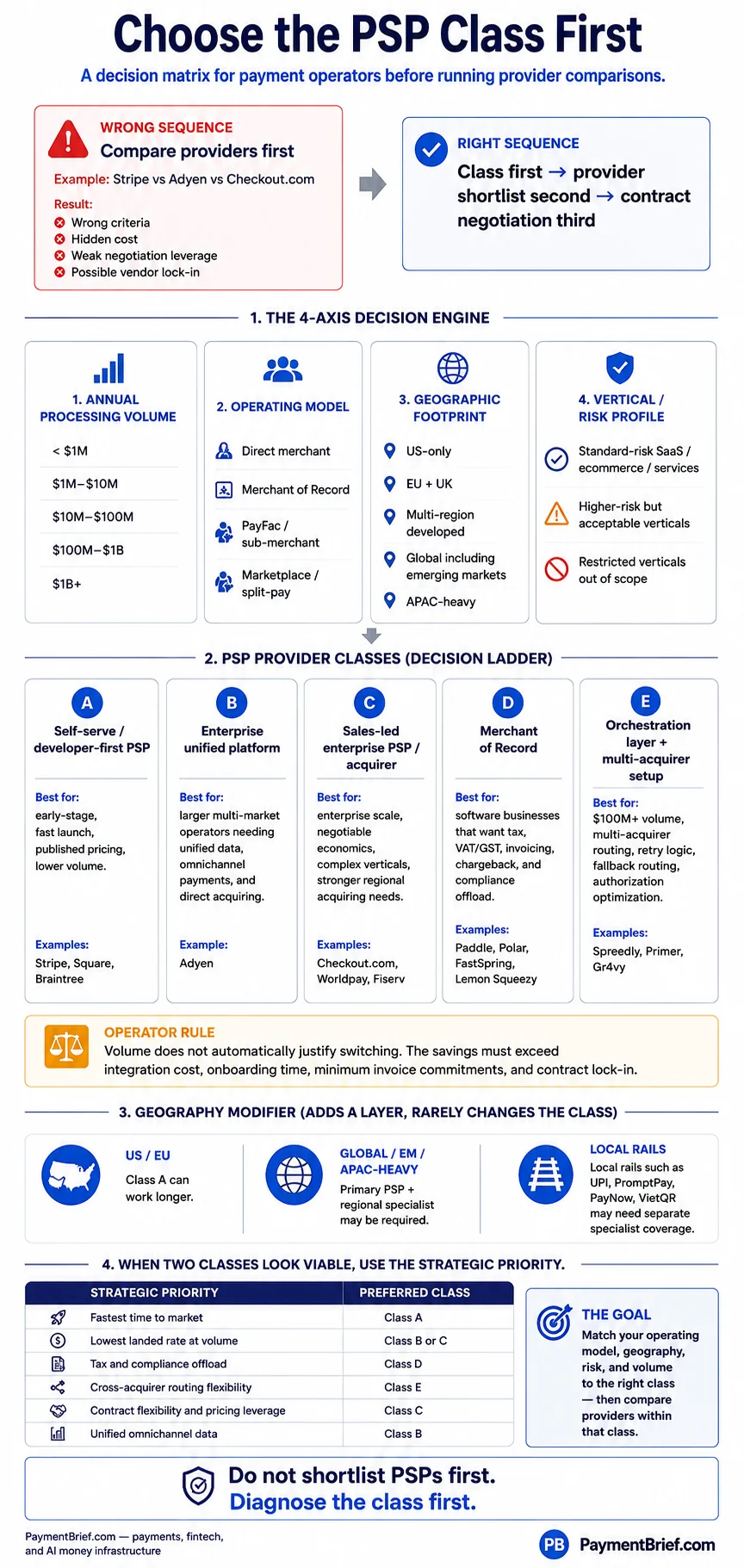
Choose the PSP class first, then compare providers inside that class.
The Short Answer
Five provider classes. Before getting to any named provider, you are choosing from one of these:
- Class A — Self-serve / developer-first PSP (Stripe, Square, Braintree)
- Class B — Enterprise unified platform (Adyen)
- Class C — Sales-led enterprise PSP/acquirer (Checkout.com, Worldpay, Fiserv)
- Class D — Merchant of Record (Paddle, Polar, FastSpring, Lemon Squeezy)
- Class E — Orchestration layer + multi-acquirer setup (Spreedly, Primer, Gr4vy over direct acquirer contracts)
The hierarchy. Operating model comes first. Volume determines pricing access. Geography modifies both. Vertical constrains acceptance. Use the matrix below to find your class, then use the head-to-heads to choose within it.
The Decision Matrix
Primary matrix: volume × operating model
Volume bands are planning bands — they indicate when the class transition economics are worth calculating, not a hard line on a specific date. The transition from one class to another is a range, not a cliff.
| Annual volume (planning band) | Direct merchant | Merchant of Record | PayFac / sub-merchant | Marketplace (split-pay) |
|---|---|---|---|---|
| <$1M / year | Class A — self-serve | Class D — MoR (operating model decision) | Class A | Class A (Stripe Connect) |
| $1M–$10M / year | Class A — begin negotiating custom rates above $3M | Class D — MoR | Class A (or Class C if vertical requires it) | Class A (Stripe Connect or Adyen for Platforms if at upper band) |
| $10M–$100M / year | Class A (negotiated IC++) or Class B/C — calculate switch economics first | Class D — MoR (review fit above $30M) | Class C (direct acquirer for volume), sometimes Class B | Class A or B — depends on in-store footprint and market coverage needs |
| $100M–$1B / year | Class B or C | Class D or beginning exit — calculate build vs buy | Class C + E (orchestration often justified here) | Class B or Class B + E |
| $1B+ / year | Class B or C + E | Class D exit — MoR premium rarely justified at this scale | Class C + E | Class B/C + E |
Geographic modifier
Geography rarely changes the class entirely but often adds a layer or shifts the enterprise class from B to C.
| Geographic footprint | Modifier |
|---|---|
| US-only | All classes viable at appropriate volume; Class A coverage is strong domestically |
| EU + UK | Class A (Stripe EU entity, Square EU) fine below $10M; Class B or C for enterprise direct acquiring and local method coverage |
| Multi-region developed (US + EU) | Class B for unified stack across markets; Class A if still scaling and direct acquiring coverage is acceptable |
| Global including EM | Primary class + regional specialist on top (Razorpay for India, PayU for LatAm); Class C (Checkout.com) for stronger EM direct acquiring |
| APAC-heavy | Class B or C for card volume; regional specialist required for local rails (UPI, PromptPay, PayNow, VietQR) — these are not handled natively by Class A/B/C |
Regional specialists are geographic modifiers, not a sixth class. They run alongside the primary class relationship — typically handling local method acceptance in markets where the primary provider's coverage is thin — rather than replacing it.
The Four Decision Axes
Axis 1 — Annual processing volume
Volume is the second-most important axis, and it primarily determines whether self-serve or sales-led pricing is accessible to you at all.
Class A providers (Stripe, Square, Braintree) publish rate cards and are immediately available to any registered business. Class B (Adyen) and Class C (Checkout.com, Worldpay) providers are sales-led and oriented toward larger or more complex merchants that need enterprise acquiring, omnichannel payment data, local payment methods, and configurable commercial arrangements. Eligibility and commercial terms for both vary by region, use case, and payment methods — operators should verify directly rather than relying on a universal volume threshold.
Volume alone does not justify a class switch. The MDR savings at Class B/C must exceed the combined cost of integration, onboarding timeline, minimum monthly invoice, and contract lock-in before the switch is economically rational. Start by decomposing your current MDR stack and understanding whether blended or IC++ pricing is structurally better for your card mix before running the class comparison.
Axis 2 — Geographic footprint
Geographic footprint determines what direct acquiring coverage you need and whether a single provider can cover your markets — or whether a regional specialist is required alongside the primary class.
Class A providers have strong coverage in US and EU/UK markets. Class B (Adyen) offers direct acquiring across 30+ markets globally, including major APAC markets, with strong omnichannel capability. Class C providers vary: Checkout.com has stronger direct acquiring in Middle East and APAC markets where Adyen's coverage is thinner; Worldpay has broad US and European reach from its legacy.
For EM-heavy or APAC-heavy footprints, the standard architecture is a regional specialist as a modifier: Razorpay for India on UPI and domestic cards, PayU for LatAm, PayMongo or local acquirers for Southeast Asia. This is not a sixth provider class — it is a geographic layer that runs alongside the primary relationship.
Axis 3 — Operating model
This is the most important axis, and the one most consistently mishandled in procurement.
Direct merchant. You are the seller of record, you accept payments on your behalf, and you carry direct liability for chargebacks, tax, and compliance in each market you operate. This covers the majority of SaaS, DTC e-commerce, travel, and marketplace businesses. Classes A, B, C, and E are all relevant depending on volume and geography.
Merchant of Record. A third-party provider — Paddle, Polar, FastSpring, Lemon Squeezy — is the legal seller in every jurisdiction. They collect from your buyer, handle VAT, GST, and local tax filings, manage chargebacks, and remit net of their take rate. This is not a PSP decision. If you are evaluating MoR providers, your decision happens in the MoR vs direct PSP comparison and the MoR provider comparison, entirely prior to this matrix.
PayFac (Payment Facilitator). You onboard sub-merchants under your master merchant account and process on their behalf. This requires Class C or A for the underlying acquiring, often Class E for sub-merchant routing logic, and carries significant compliance overhead including KYB, AML, and dispute liability. Class B is possible via a custom Adyen for Platforms arrangement.
Marketplace (split-pay). You collect from buyers and split disbursements across multiple sellers. Stripe Connect and Adyen for Platforms handle this natively. Class C providers can accommodate split-pay with custom integrations.
Axis 4 — Vertical and risk profile
Vertical affects underwriting acceptance, available payment methods, and sometimes pricing structure.
Standard-risk verticals — SaaS, mainstream e-commerce, professional services, travel, subscription software — have full access to all five classes at appropriate volume. Higher-risk but standard-acceptable verticals — online gaming in licensed markets, regulated financial services, high-ticket e-commerce — may require Class C sales-led providers who underwrite these categories directly, or specialist acquirers.
Out of scope for this matrix: Restricted verticals including adult content, unlicensed gambling, regulated substances, and the majority of crypto activity require specialist acquirers with structurally different operating models. This matrix does not apply to those verticals.
Tiebreaker Matrix
When the primary matrix returns two candidate classes, use strategic priority to break the tie.
| Strategic priority | Favors | Why |
|---|---|---|
| Fastest time to market | Class A | Published rates, self-service onboarding, same-day integration start |
| Lowest landed rate at volume | Class B or C | True IC++ pass-through at enterprise scale outperforms negotiated blended rates once card mix and scheme fees are correctly modeled |
| Unified omnichannel data and auth-rate optimisation | Class B | Single data model across in-store, online, and mobile; ML auth optimisation built on full transaction history |
| Tax and compliance offload globally | Class D | MoR assumes VAT, GST, and chargeback liability; no other class offers this |
| Cross-acquirer auth optimisation and routing flexibility | Class E (with B or C) | Routing decisions decoupled from individual acquirer integrations; retry and fallback logic centralised |
| Contract flexibility and pricing leverage | Class C | Sales-led model means more negotiable commercial terms; Worldpay and Checkout.com have broader appetite for bespoke contract structures than Class B |
The Provider Classes, Explained
Class A — Self-serve / developer-first PSP
Named examples: Stripe, Square, Braintree (PayPal subsidiary)
Class A providers publish rate cards, are available immediately to any registered business, and prioritize developer experience. Stripe's US published rate of 2.9% + $0.30 for card-not-present, combined with comprehensive API documentation and pre-built Checkout and Elements UIs, allows a capable developer to be live on card acceptance within a day. Square is US-focused, optimized for SMB and point-of-sale alongside online channels. Braintree (owned by PayPal) adds native PayPal wallet acceptance and has historically been the choice for businesses with meaningful PayPal conversion exposure.
Wins when: Volume is below the minimum thresholds for enterprise direct contracts, time to market matters more than rate optimization, or embedded payment features (Stripe Capital, Stripe Issuing, Stripe Connect for marketplaces, Square Banking) are strategically important. Stripe was the 6th-largest US merchant acquirer in the Nilson Report 2025 ranking; its Auth Boost and network token coverage have materially closed the auth-rate gap with enterprise providers.
Loses when: Card mix includes a high proportion of regulated EU debit (where true IC++ pricing is significantly cheaper than blended), monthly processing clears the enterprise minimum thresholds, or coverage gaps in specific markets require direct acquiring that Class A does not offer.
Key question before staying: Can you negotiate custom IC++ pricing, and does the saving exceed what an enterprise class switch would cost? Stripe's published pricing is flat-rate and self-serve; larger or more complex businesses can contact Stripe for custom pricing, but Stripe does not publish a single universal threshold for when custom commercial terms apply. Operators should treat this as a negotiation path, not a fixed eligibility line.
Head-to-head comparisons: Stripe vs Adyen vs Checkout.com pricing teardown, Braintree vs Stripe operator guide, Stripe vs Square operator guide
Class B — Enterprise unified platform
Named example: Adyen
Class B is effectively a single-provider description: Adyen is the only scaled global provider operating the enterprise unified platform model. One contract, one data model, one reconciliation feed across 30+ markets with direct acquiring, full omnichannel capability (online, in-store, mobile) under a single platform. Pricing is IC++ with a published indicative markup of ~0.60% + $0.13 per transaction; actual contract rates are volume-negotiated and scale down with volume. Adyen processed €1,394.3B in volume and €2,364.2M in net revenue in FY2025, and entered the Nilson Top 10 US acquirers for the first time in 2025.
Wins when: You have meaningful in-store and online volume that you want unified under one platform (retailers, airlines, travel, omnichannel brands); you are enterprise with multi-market requirements where a single acquiring relationship simplifies reconciliation and contract management significantly; or unified transaction data for fraud modelling, auth optimisation (Adyen Uplift claims +6% authorization rate), and customer insight is a genuine strategic priority.
Loses when: Your business is not yet at a scale or complexity where Adyen's enterprise acquiring, omnichannel data model, and configurable commercial arrangements offer a meaningful advantage over a self-serve provider; you are digital-native with no in-store footprint (the omnichannel unification advantage matters less); or your volumes are concentrated in EM markets where Adyen's direct acquiring is thinner than Checkout.com.
Key question before switching: Is omnichannel data unification a genuine current priority, or a hypothetical future benefit? If it is not immediately material, Class C may offer comparable acquiring economics with more commercial flexibility.
Head-to-head comparisons: Stripe vs Adyen vs Checkout.com pricing teardown, Adyen vs Worldpay for European enterprise
Class C — Sales-led enterprise PSP/acquirer
Named examples: Checkout.com, Worldpay (GTCR/FIS), Fiserv
Class C providers are sales-led, publish no rate cards, and focus on enterprise-scale merchants. All pricing — processing, disputes, FX, 3DS, payouts — is behind a sales engagement. Industry reporting puts Checkout.com's enterprise rates at approximately interchange + 0.10–0.40% + $0.08 per transaction, but every line item is negotiated. Worldpay carries broad US and European direct acquiring reach; Checkout.com has stronger EM and APAC direct acquiring coverage and is heavily concentrated in digital-native verticals (crypto, gaming, streaming, BNPL). Checkout.com processed $300B+ in 2025 with 63 merchants doing $1B+ annually.
Wins when: You are at enterprise scale with real negotiating leverage; your business vertical (gaming, streaming, crypto, high-volume digital goods) is a strength for Checkout.com's underwriting; or your geographic mix is EM-heavy or APAC-heavy where Checkout.com's direct acquiring is stronger than Adyen. Worldpay wins for operators with existing European enterprise acquiring relationships and a preference for contract flexibility over platform unification.
Loses when: You are not at enterprise scale and the sales-led model produces a contract that does not reflect your actual volume; you need unified omnichannel data (Class B); or you want embedded platform infrastructure (Class A or B).
Key question before switching: Do you have enough volume to negotiate the contract down to the economics that justify the onboarding cycle and minimum invoice commitment? Enterprise PSP onboarding typically runs 8–16 weeks — the opportunity cost is real.
Head-to-head comparisons: Stripe vs Adyen vs Checkout.com pricing teardown, Adyen vs Worldpay for European enterprise
Class D — Merchant of Record
Named examples: Paddle, Polar, FastSpring, Lemon Squeezy
Class D is a different operating model, not a payment processing choice. A Merchant of Record provider acts as the legal seller in every jurisdiction your buyers are located. They collect from your buyer, handle VAT and GST filings, manage chargebacks and refunds, and remit net of their take rate. MoR pricing is often materially higher than direct PSP processing because the MoR is taking on seller-of-record, tax, invoicing, compliance, and payment operations responsibilities. In operator planning, a 5–8% all-in range is a useful estimate, but actual rates vary by provider, product, country mix, and contract.
Wins when: You sell software internationally and want to eliminate multi-jurisdictional VAT registration, GST filing, and tax remittance overhead. The take-rate premium over a direct IC++ contract is the cost of the compliance and tax infrastructure, not pure PSP margin. For many SaaS businesses under $50M in annual revenue with significant international exposure, the total cost of ownership comparison favors MoR even at the higher headline rate.
Loses when: Revenue has grown to the point where the MoR take rate — as an absolute dollar amount — materially exceeds the cost of building and operating the tax compliance infrastructure directly. Also loses when MoR operating constraints (product control, revenue recognition, customer relationship ownership) become strategic blockers for sales-led or enterprise B2B business.
Critical distinction: The Merchant of Record decision precedes this matrix entirely. If you are currently on a Class A PSP and considering MoR, that is an operating-model migration — it is not a PSP switch. See when Merchant of Record stops making sense and the MoR migration playbook before re-entering this matrix.
Deep-dives: Merchant of Record vs Direct PSP — When to Switch, MoR Provider Comparison: Paddle, Polar, FastSpring
Class E — Orchestration layer + multi-acquirer setup
Named examples: Spreedly, Primer, Gr4vy (as the orchestration layer); with direct acquirer contracts underneath
Class E is an architecture choice layered on top of one or more Class A, B, or C providers. An payment orchestration layer handles routing decisions, retry logic, and fallback rules centrally, decoupled from individual PSP integrations. It is most powerful when an operator holds direct relationships with two or more acquirers and needs to route traffic based on auth rate, cost, or corridor economics without rebuilding that logic inside a monolithic integration.
Wins when: You have genuine multi-acquirer requirements (typically $100M+ in volume), complex routing or retry logic that benefits from a dedicated layer, or a need to add a second PSP without rewriting the core integration. The multi-acquirer routing article covers the economics and hidden operational complexity in detail.
Loses when: The overhead of adding an orchestration layer — integration build, latency exposure, reconciliation complexity, an additional vendor contract — outweighs the auth-rate or cost benefit. At most volumes below $100M, directly managing two PSP integrations is operationally viable without a dedicated orchestration layer.
Head-to-head comparison: Spreedly vs Primer vs Gr4vy: Payment Orchestration Compared
Edge Cases Where the Matrix Breaks
Hybrid operating models. Some businesses operate as a direct merchant in their home market and as a Merchant of Record in international markets where the tax compliance overhead is highest. This is a legitimate two-class architecture, but it requires careful attention to revenue recognition and customer-relationship ownership on each side of the split.
Multi-entity, multi-brand operators. This matrix picks a provider class per business; it does not answer how many merchant IDs a group with several legal entities or brands actually needs, or how those MIDs should map to settlement accounts and dispute exposure. That's a structural decision layered on top of the class choice, covered in multi-entity, multi-MID payment architecture.
High-growth crossing volume tiers mid-contract. The matrix identifies a starting class — it does not protect against outgrowing your provider while locked into a contract. If you are in a Class A contract at $8M and growing at 2x annually, negotiating exit flexibility before signing is essential. Read PSP contract red flags and the hidden costs of PSP vendor lock-in before committing to any multi-year deal.
Multi-rail businesses. Operators in markets where local payment methods — Pix in Brazil, UPI in India, real-time rails in Southeast Asia — represent material volume should evaluate local method acceptance separately from the card-acquiring class. The matrix covers card acquiring. Local rail acceptance is typically handled by a regional specialist alongside the primary class, or by choosing a Class B/C provider with stronger local method coverage in those markets. For local rail details, see the real-time payment rails comparison matrix.
Restricted verticals. Online gaming in regulated markets, adult platforms, and regulated financial products require specialist acquirers with structurally different underwriting criteria, pricing, and payment-method availability. The five-class matrix does not apply.
What to Read Next
If you are at Class A evaluating whether to stay:
Read the MDR stack decomposition to understand whether blended pricing is costing you more than IC++ would at your card mix. Read interchange-plus vs blended pricing for the structural comparison. If negotiating custom rates, see the PSP negotiation playbook.
If you are evaluating a switch from Class A to Class B or C:
Start with the Stripe vs Adyen vs Checkout.com pricing teardown for the landed-cost comparison. Read PSP contract red flags and PSP vendor lock-in costs before signing. The understanding PSP contracts guide covers the clauses that quietly drain margin.
If you are deciding between a PSP, a payment facilitator and a merchant of record as operating models:
The PSP and PayFac operations reference lays the three side by side on settlement, reserves, chargeback responsibility and reporting, and is the place to settle which seat you are actually in before comparing providers within it.
If you are weighing a merchant of record, or already using one:
Read the Merchant of Record operating-model reference first. It separates the commercial label from the scheme classification the arrangement actually receives, and sets out who is liable to whom — which decides whether this matrix even applies to you.
If you are considering an MoR exit to direct PSP:
Read when Merchant of Record stops making sense first, then the MoR migration playbook from Paddle/Polar to direct PSP.
If you are adding a second PSP or considering an orchestration layer:
Start with multi-acquirer routing for the economics and operational complexity. If routing logic has grown beyond what direct integration can handle, see Spreedly vs Primer vs Gr4vy.
The full PSP Switching reading list — from the operating model decision through pricing, lock-in, contract traps, negotiation, and multi-acquirer setup — is at PSP Switching Reading List.
Sources & methodology (11)
Stripe US card-not-present standard published rate
2.9% + $0.30
Checked:
Stripe UK standard UK card rate
1.5% + 20p
Checked:
Adyen indicative acquirer markup
~0.60% + $0.13 per transaction
Indicative rate published by Adyen; actual contract rates are volume-negotiated
Checked:
Adyen FY2025 total processed volume
€1,394.3B (+21% YoY excl. one large customer departure)
Checked:
Adyen FY2025 net revenue
€2,364.2M (+18% YoY)
Checked:
Checkout.com 2025 total processed volume
$300B+
Company-disclosed figure
Checked:
Checkout.com merchants processing $1B+ annually
63
Company-disclosed figure
Checked:
Stripe ranked 6th-largest US merchant acquirer
Cited via PaymentBrief Stripe vs Adyen vs Checkout.com pricing teardown
Checked:
Adyen entered Nilson Top 10 US acquirers for first time
2025
Cited via PaymentBrief Stripe vs Adyen vs Checkout.com pricing teardown
Checked:
Stripe named Leader in Forrester merchant payment provider wave
2026
Checked:
Merchant of Record effective take rate range
5–8% all-in (processing + tax compliance + platform fee)
PaymentBrief's own estimate, not a figure taken from the linked article — that reference deliberately declines to publish a take-rate comparison on the grounds that providers revise pricing more than once a year and structures differ (flat take rate, transaction fee, or a blend). The link is context for the model, not the source of this range. Derived from published Paddle, FastSpring and Lemon Squeezy rate structures at the access date; varies by volume and product vertical, and should be re-checked against current provider pricing before use.
Checked:
Source types explained in our Methodology.
 By Shaun Toh · Director, Digital Payments · Razer